


Posted by:
Category:
Comments:
Post Date:
The Ultimate Guide to Industrial Panel Sockets and Wall Sockets for UAE Workspaces & Heavy-Duty Sites
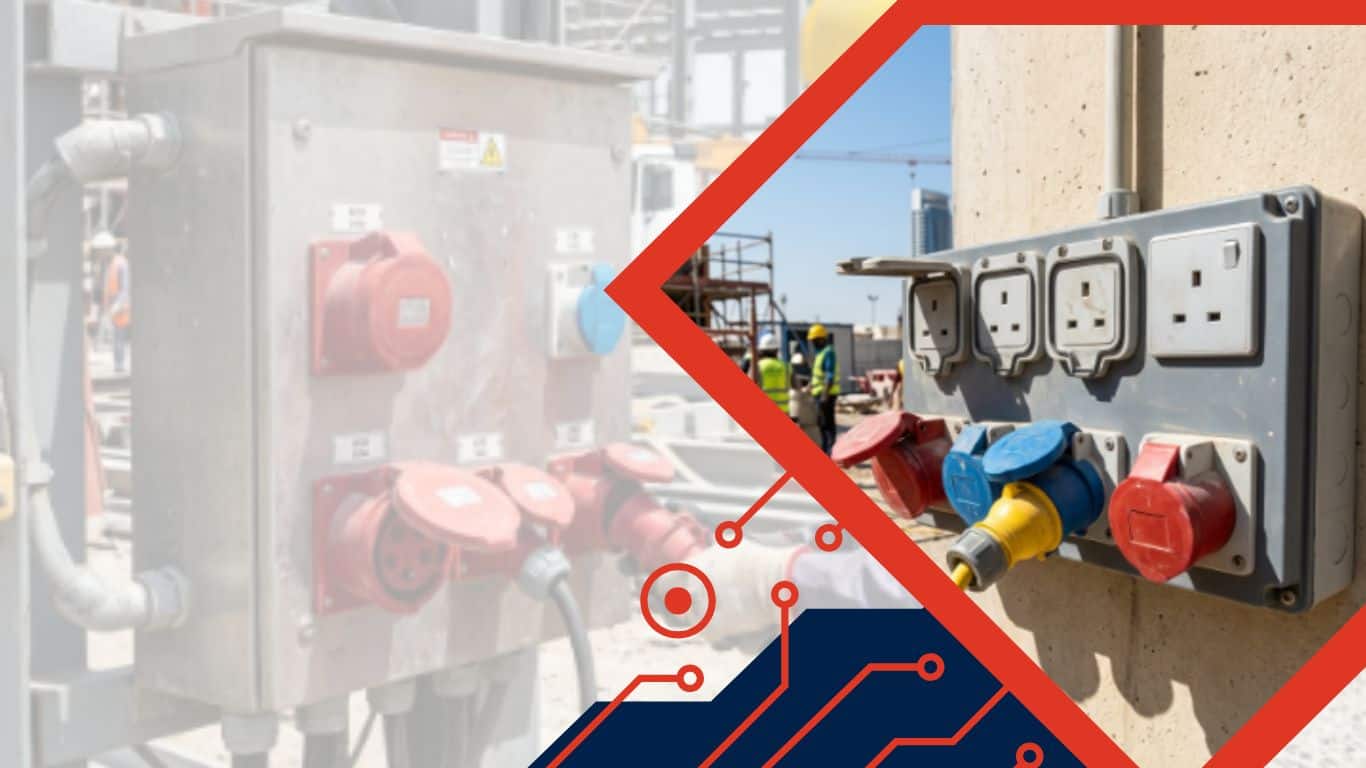
A socket that works in a clean office may fail quickly on a workshop floor, generator panel, warehouse loading bay, or construction site. That's why you must select industrial panel sockets and industrial wall sockets based on the actual electrical load, mounting method, ingress exposure, and maintenance conditions.
Here is what matters most.
Why Industrial Socket Selection Is a Bigger Decision in the UAE

Electrical outlets in industrial environments do more than provide a convenient connection point. They become part of the operating infrastructure for tools, motors, temporary distribution, production equipment, pumps, HVAC equipment, generators, and maintenance systems.
In Dubai, DEWA specifies a nominal electrical supply of 230/400 V at 50 Hz. Abu Dhabi's Department of Energy specifies 230 V single-phase or 400 V three-phase at 50 Hz. These requirements give engineers a clear supply framework, but they don't remove the need to match every socket to the actual circuit, equipment, current rating, and installation environment. The UAE adds another layer of difficulty. Equipment can face heat, airborne dust, humidity, wash-down cleaning, vibration, and repeated plug-in cycles.
Start With the Standard: Why IEC 60309 Matters
For heavy-duty industrial connections, IEC 60309 is a key reference point.
IEC 60309-1:2021 covers plugs, fixed or portable socket-outlets, and appliance inlets primarily intended for industrial use. The standard applies to accessories with rated operating voltages up to 1,000 V AC or DC, frequencies up to 500 Hz, and rated currents up to 800 A. IEC 60309-2:2021 adds dimensional compatibility requirements for pin-and-contact-tube accessories with rated currents up to 125 A. That standardization is valuable because it creates a consistent system around voltage class, pin arrangement, current rating, and mechanical compatibility.
In practical terms, it helps electricians identify the correct connection faster and reduces the chance of connecting equipment to an unsuitable outlet. For a project team sourcing an industrial socket, treat the applicable standard as a specification starting point rather than a marketing feature.
Panel-Mounted or Wall-Mounted? Solve This First
Industrial panel sockets are designed to become part of an enclosure, machine face, generator panel, control cabinet, or distribution assembly. They create a clean fixed connection point without adding a bulky external surface box. By contrast, industrial wall sockets are fixed to a wall, structural surface, machine body, or suitable enclosure where a surface-mounted connection is more practical.
The difference sounds simple.
But it affects cable routing, service access, weather exposure, replacement time, plug clearance, and the strain the connected cable puts on the assembly.
Where a Panel Connection Makes the Most Sense
A panel connection is often the better choice on generator sets, distribution boards, test rigs, industrial machines, welding systems, maintenance skids, and portable power carts. A well-selected industrial panel socket allows the connection to sit neatly within the enclosure while keeping most wiring protected behind the panel. This arrangement can make inspection easier by grouping the socket, protective device, labels, and controls into one organized assembly.
For compact installations, pay close attention to the depth behind the mounting face. The socket body, conductor bend radius, terminals, and cable management all need room. And here is where rushed panel design causes problems. A neat front face means very little if the wiring behind it is compressed, difficult to inspect, or under mechanical stress.
When Surface Mounting Is the Smarter Move
Workshops and fixed service areas often benefit from surface-mounted outlets because technicians need power exactly where equipment is used.
Industrial wall sockets work well for maintenance bays, production zones, loading areas, covered outdoor work points, warehouses, plant rooms, and machine service stations. A surface unit can be easier to replace because access does not always require opening a larger control panel. It can also simplify future changes. If the process layout moves, a surface-mounted point may be easier to relocate than a socket integrated directly into a machine enclosure. For buyers comparing fixed surface outlets, check cable-entry direction, enclosure strength, lid design, gland compatibility, and the available space around the plug.
Straight, Angled, and Flanged Designs Are Not Interchangeable
A straight panel design presents the socket perpendicular to the face. That works well where there is enough clearance in front of the equipment and the connected cable can leave the plug without excessive bending. Industrial angled panel sockets change the cable exit direction. This can reduce projection and help the connected cable fall naturally downward, especially on mobile distribution equipment, machine skirts, cabinet returns, or tightly packed control systems. Flanged panel sockets provide a defined mounting surface around the socket body, which can make fixing and sealing more straightforward depending on the product design. Choose based on cable path, plug clearance, panel thickness, enclosure sealing, and how technicians will connect and disconnect the equipment.
GO Switchgear's current IEC 60309 range includes wall, straight panel, and angled panel formats, letting installers choose a body style for the installation rather than forcing one mounting format into every application.
Voltage, Phase, and Pin Count Must Tell the Same Story
A common IEC 60309 single-phase arrangement uses three pins: line, neutral, and protective earth. Three-phase arrangements may use four pins for three phases plus earth, or five pins where neutral is also required.
A 3-pin industrial wall socket can therefore serve a single-phase application when the voltage, current rating, earthing arrangement, and equipment requirements match. Three-phase machinery may still need a neutral for controls, lighting, electronics, or auxiliary loads, even when the main motor does not.
IP Ratings: The Number That Protects Against the Environment
Ingress protection deserves serious attention in UAE projects. IEC 60529 defines the IP Code used to classify the protection level of electrical enclosures and helps engineers select the right UAE electric socket and industrial connection solutions for different environmental conditions.
For industrial connectors, IP44 and IP67 are common decision points.
An IP44 design is generally suited to locations where splash protection is sufficient, and the connection does not face severe dust or direct wash-down conditions. IP67 provides a much stronger environmental barrier and is widely used where dust and water exposure are more demanding.
GO Switchgear's KableKonnect Classic offering includes IP44 products for protected and lighter-duty applications, while the KableKonnect Pro range is positioned around IP67 protection for harsher operating conditions. That split makes specification easier once environmental conditions are clearly defined.
Why Dust, Heat, and Contact Quality Belong in the Same Conversation

Environmental protection is not only about keeping a socket looking clean. Contamination and temperature can influence electrical contact behavior.
A 2021 experimental study published in Sensors and Actuators A: Physical examined the temperature dependence of electrical contact resistance in power connectors. The researchers reported that electrical contact resistance plays an important role in connector thermal behavior and discussed factors including surface condition, pressure, debris, and oxide formation at contact interfaces.
Good contact pressure, clean terminations, correct materials, secure assembly, and suitable environmental protection all work together. The wall mount industrial socket should not be treated as an isolated plastic housing.
Panel Cutouts Need Precision, Not "Close Enough"
A panel mounted industrial socket depends heavily on the opening into which it is installed. The cutout should match the manufacturer's dimensional information. Mounting holes need accurate positioning.
The panel surface should allow the flange or sealing arrangement to seat correctly. If the opening is oversized, mechanical fixing can become weak. If it is undersized, installers may try to force the body into position or modify the opening after the enclosure is finished.
Before fabrication, confirm:
- Cutout dimensions
- Mounting-hole pattern
- Overall connector dimensions
- Panel thickness requirements
- Rear clearance
- Socket orientation
- Gasket or sealing requirements
On repetitive control-panel work, standardized cutouts can also reduce fabrication time and mistakes across multiple assemblies.
Interlocking Adds Control Where Disconnection Under Load Is a Risk
Some heavy-duty environments need more than a conventional socket and protective lid. Interlocked wall sockets combine the connection point with an interlocking or switching arrangement intended to control the connection and disconnection sequence. This approach can be valuable where disconnecting equipment under load presents a significant operational risk or where the operating procedure calls for additional control. For factories, processing areas, maintenance facilities, and heavy equipment, that additional layer may be better designed into the installation from the beginning than added later.
Distribution Boards Need a Layout Technicians Can Read Fast
An Industrial socket panel board should be easy to understand at a glance. Socket labels should clearly identify the circuit, voltage, phase arrangement, and current rating where appropriate. Protective devices should be grouped logically. Different voltage systems should be identified clearly.
Cable routes should not cross other components in ways that make inspection or replacement difficult. Ensure enough physical spacing for all required plugs to connect. This final point is easy to miss. Two socket bodies can fit neatly on a CAD drawing but become impractical once you add large plugs, locking rings, cable glands, and flexible cables. A full-size layout check before fabrication can prevent that problem.
UAE Compliance Should Be Checked Before Procurement Is Closed
Electrical components used on UAE projects must meet the requirements for their product category and installation. DEWA's electrical installation regulations require equipment, apparatus, materials, and accessories to be appropriately designed and rated for the local electrical supply and intended operating conditions. Abu Dhabi's Electricity Wiring Regulations similarly set local low-voltage electrical parameters and the installation framework. At the product level, the UAE Ministry of Industry and Advanced Technology operates conformity systems and provides a searchable product-conformity database that includes electrical product categories.
Do not rely on appearance, color, or a basic online listing alone. Ask for the technical datasheet, ratings, applicable standards, IP classification, and any conformity documentation required by the project specification or authority.
Domestic Type G Sockets and IEC 60309 Sockets Serve Different Jobs
One frequent source of confusion in mixed commercial-industrial projects is the word "socket." A standard Type G outlet is common in offices, commercial interiors, accommodation areas, and general building services.
IEC 60309-style connections serve industrial applications where rugged construction, higher-current options, phase configuration, frequent connection cycles, and environmental sealing may matter more. If a project team is comparing conventional building outlets, GO Switchgear's UAE power socket information should be considered separately from industrial connector selection. Trying to make one socket format serve every environment creates poor engineering compromises. Use industrial systems where electrical duty, mechanical handling, and environmental exposure justify them.
What to Look for When Buying From a Supplier
A strong supplier should help narrow the product by technical requirement rather than simply show a catalog. For fixed surface outlets, ask whether the required current, voltage class, pin count, and IP rating are available within the same family. For panel products, request mounting dimensions and cutout information before fabricating metalwork.
Check whether matching plugs and in-line connectors are available. Ask about compatible cable, glands, terminals, and circuit-protection products. For larger projects, consistent product families can simplify spares and maintenance. As of September 2026, GO Switchgear's product catalog lists 35 products within its Industrial Plugs & Sockets (IEC 60309) category, alongside its wider range of panel-building and electrical components.
Maintenance: Catch Problems Before They Become Downtime

Industrial sockets should form part of planned electrical inspections.
Look for:
- Heat discoloration
- Cracked housings
- Damaged protective covers
- Loose mounting hardware
- Dirt or contamination
- Corrosion
- Deformed contacts
- Cable-gland movement
- Signs of overheating
- Evidence of arcing
- Loose or damaged conductors
Check that labels remain readable.
Confirm that plugs insert and withdraw normally without abnormal force. If a connection has been struck, contaminated, or exposed to unexpected water ingress, inspect it before returning the circuit to normal service.
Research into electrical contact resistance reinforces why this matters: contact condition, contamination, oxide formation, pressure, and temperature can all influence the behavior of electrical connection interfaces.
A Fast Selection Checklist for Engineers and Procurement Teams
Before approving a purchase order, confirm every item below:
- Supply voltage
- Frequency
- Single-phase or three-phase operation
- Neutral required or not required
- Current rating
- Pin count
- Required IP rating
- Mounting method
- Straight or angled cable exit
- Panel cutout or wall fixing requirements
- Cable type
- Conductor cross-section
- Cable gland size
- Circuit protection
- Earthing arrangement
- Enclosure clearance
- Matching plug configuration
- Applicable IEC requirements
- Required UAE conformity documentation
- Quantity
- Spare units
- Labeling requirements
This checklist is intentionally practical.
It catches the small specification mismatches that can turn into costly delays during installation and commissioning.
Conclusion
The best industrial power connection is easy to identify, hard to misuse, properly protected, simple to maintain, and correctly coordinated with the surrounding circuit. That is the real value of specifying the right industrial panel sockets and industrial wall sockets. For UAE projects, the process starts with voltage, phase, current, environment, and mounting method.
It continues with cable selection, circuit protection, enclosure design, accessibility, and compliance. It ends with a connection technicians can use confidently every day.
FAQs
What Is the Main Difference Between Panel and Wall Industrial Sockets?
Panel versions are fitted through the face of an enclosure, machine, or distribution assembly. Wall versions are surface-mounted to a wall, structural surface, machine body, or separate enclosure. The correct choice depends on cable routing, service access, physical space, environmental exposure, and where the connection logically belongs.
When Should I Choose IP67 Instead of IP44?
Choose ingress protection according to the actual installation environment and project requirements.IP67 is generally better suited to demanding conditions involving significant dust or water exposure. IP44 can be appropriate in more protected locations where its level of splash and solid-object protection is sufficient. Do not automatically specify the highest rating without reviewing the complete enclosure and installation.
Are 16 A and 32 A Industrial Sockets Physically the Same?
No. IEC 60309 connector dimensions and configurations differ according to rating. A 32 A plug is not intended to mate with a 16 A socket merely because the connectors share a similar voltage color. Always confirm the rated current and connector configuration.
What Is the Advantage of an Angled Panel Socket?
An angled connection can reduce how far the plug projects outward from the panel. It can also encourage the cable to drop downward rather than making a sharp bend immediately after the plug. This is particularly helpful on compact distribution equipment, machine cabinets, mobile power carts, and installations with limited front clearance.
Do I Need a Neutral on a Three-Phase Socket?
It depends on the connected equipment. Some three-phase loads operate without neutral. Other machines require neutral for control circuits, internal lighting, electronics, fans, or other single-phase auxiliaries. Check the equipment wiring diagram before choosing between a configuration with or without neutral.
Can I Use One Socket Family Across an Entire Project?
Yes, as long as the electrical ratings, mounting requirements, and environmental conditions match. Standardizing appropriate connector families can simplify procurement, spare-parts inventory, maintenance, training, and labeling. However, standardization should not force an under-specified component into a harsher environment simply to reduce the number of products on the bill of materials.
Share this post

Related
Posts

Wire Connectors for Downlights & LED Strips: A UAE Fit-Out Guide (2026)
Which KableKonnect PCT connector for downlight chains, driver-fed clusters, LED strip runs and ceiling roses. Featuring the SPL deconcentrator range...
Electrical Wire Connectors in Dubai: A Panel Builder’s Sourcing Guide (2026)
What actually costs what for electrical wire connectors in Dubai — WAGO vs KableKonnect PCT alternatives, MEP spec compliance routes,...
WAGO 221 vs WAGO 222: Which Lever Wire Connector Do You Need? (2026 UAE Guide)
The 221 splices multiple wires from one side. The 222 passes a run through, in on one edge, out the...
Push-in Wire Connectors in the UAE: WAGO 221 Alternatives, Types, Ratings & Full Buying Guide (2026)
Every push-in wire connector we stock — 33 SKUs across 8 series — with the exact WAGO equivalent, ratings, use...
.jpg)