
.jpg)

Posted by:
Category:
Comments:
Post Date:
Selecting the Right Step Down Transformer for UAE & GCC Projects
Connecting high-voltage power from the grid directly to low-voltage equipment is like using a fire hose to fill a teacup—it’s inefficient, dangerous, and guarantees damage. A step down transformer is the essential control nozzle in this scenario, precisely reducing high utility voltages to safe, usable levels for your machinery, control panels, and sensitive electronics. This process is the foundation of nearly every electrical system across the UAE and GCC.
Why Step Down Transformers Are Essential for UAE Infrastructure
In the UAE and across the GCC, the electrical grid must support everything from Dubai's high-tech data centres to massive industrial zones in KSA. This is where step down transformers become a non-negotiable component. They act as the critical bridge between high-voltage power from utilities like DEWA or ADDC and the lower voltages required by building systems and industrial equipment.
Attempting to bypass this step is catastrophic. Connecting equipment directly to a high-voltage source would lead to immediate failure. These transformers ensure operational safety and protect expensive assets by precisely reducing voltage, shielding them from overvoltage damage and grid fluctuations common in the region.
A Look Under the Hood: Core Components and How It Works
A step down transformer operates on the principle of electromagnetic induction and consists of three primary parts. Understanding these is the first step for any engineer or panel builder specifying a unit.
- Primary Winding: The input coil connected to the high-voltage source from the grid.
- Secondary Winding: The output coil where the reduced, lower voltage is delivered to the load.
- Iron Core: Both windings are wrapped around this magnetic core, which concentrates the magnetic field to ensure efficient energy transfer.
The voltage reduction is achieved through the turns ratio. A step down transformer has more turns of wire on its primary winding than its secondary winding. This physical design dictates the voltage drop as power passes through.
For procurement teams and electricians in the UAE, this principle is critical. The turns ratio directly determines the output voltage, making it the most important specification when matching a transformer to project requirements, whether for an HVAC system, a lighting circuit, or as part of an energy management solution Dubai requires.
With this foundation, you can select the ideal transformer from a trusted supplier of electrical components UAE like GoSwitchgear for your project's unique needs.
Understanding How Transformers Reduce Voltage
A transformer operates on the principle of electromagnetic induction, changing voltage levels with high efficiency and no moving parts. For any engineer, panel builder, or electrician in the UAE, a firm grasp of this concept is essential for accurate specification.
When alternating current (AC) flows through the primary winding, it creates a fluctuating magnetic field within the transformer's iron core. This magnetic field is channelled through the secondary winding, where it induces a new current. The genius lies in the turns ratio.
The Turns Ratio in Action
The voltage change is determined by the number of wire turns on each coil. In a step down transformer, the primary winding always has more turns than the secondary winding. This physical difference forces the voltage to decrease.
The formula is straightforward:
Vp / Vs = Np / Ns
- Vp = Primary Voltage (input)
- Vs = Secondary Voltage (output)
- Np = Number of turns on the primary winding
- Ns = Number of turns on the secondary winding
Consider a real-world UAE scenario: a commercial tower in Dubai receiving power from a DEWA substation at 11,000 volts (11kV). The building's systems require a much safer 400V. To achieve this, the transformer's primary winding must have 27.5 times more turns than its secondary winding (11,000V / 400V = 27.5). This precise ratio ensures reliable voltage reduction.
The Give-and-Take of Voltage and Current
Due to the law of conservation of energy, when voltage is stepped down, current is stepped up. Power (minus minor efficiency losses) remains constant.
This inverse relationship is defined as:
Vp / Vs = Is / Ip
- Is = Secondary Current (output)
- Ip = Primary Current (input)
In our Dubai tower example, reducing the voltage from 11kV to 400V increases the available current by a factor of 27.5. High voltage is efficient for long-distance transmission, but it is the high current that powers heavy loads like massive HVAC systems, elevators, and industrial machinery.
For engineers and panel builders, this relationship is paramount. Cables and circuit protection on the secondary side must be sized to handle the increased current safely. This is where components like breakers and busbars in GoSwitchgear's range of low voltage switchgear become critical.
Why Quality and Efficiency Are King in the GCC
Not all transformers perform equally, especially in the demanding GCC climate. During voltage conversion, some energy is lost as heat through two primary mechanisms:
- Copper Losses (I²R losses): Heat generated by current flowing through the resistance of the copper windings.
- Iron Losses (Core Losses): Energy lost within the magnetic core due to hysteresis and eddy currents.
In the high ambient temperatures of the UAE, these losses can cause a transformer to overheat, shortening its lifespan and reducing efficiency. Opting for a high-efficiency step down transformer from a trusted supplier like GoSwitchgear minimizes energy loss, leading to lower electricity bills, reduced strain on cooling systems, and greater reliability—all essential for successful projects in the region.
Choosing Between Dry-Type and Oil-Immersed Transformers
Selecting the right step down transformer for a project in the UAE or GCC involves a critical decision between two main types: dry-type and oil-immersed. This choice is driven by application, safety requirements, installation environment, and maintenance considerations.
The fundamental difference is their cooling method. Dry-type transformers use air circulation (sometimes fan-assisted), while oil-immersed transformers are filled with mineral oil that serves as both a coolant and an insulator. This distinction dictates where each type can be safely and effectively deployed.
At the core of both designs is the principle of electromagnetic induction. An incoming AC current creates a changing magnetic field, which in turn induces a new AC current in the outgoing coil.
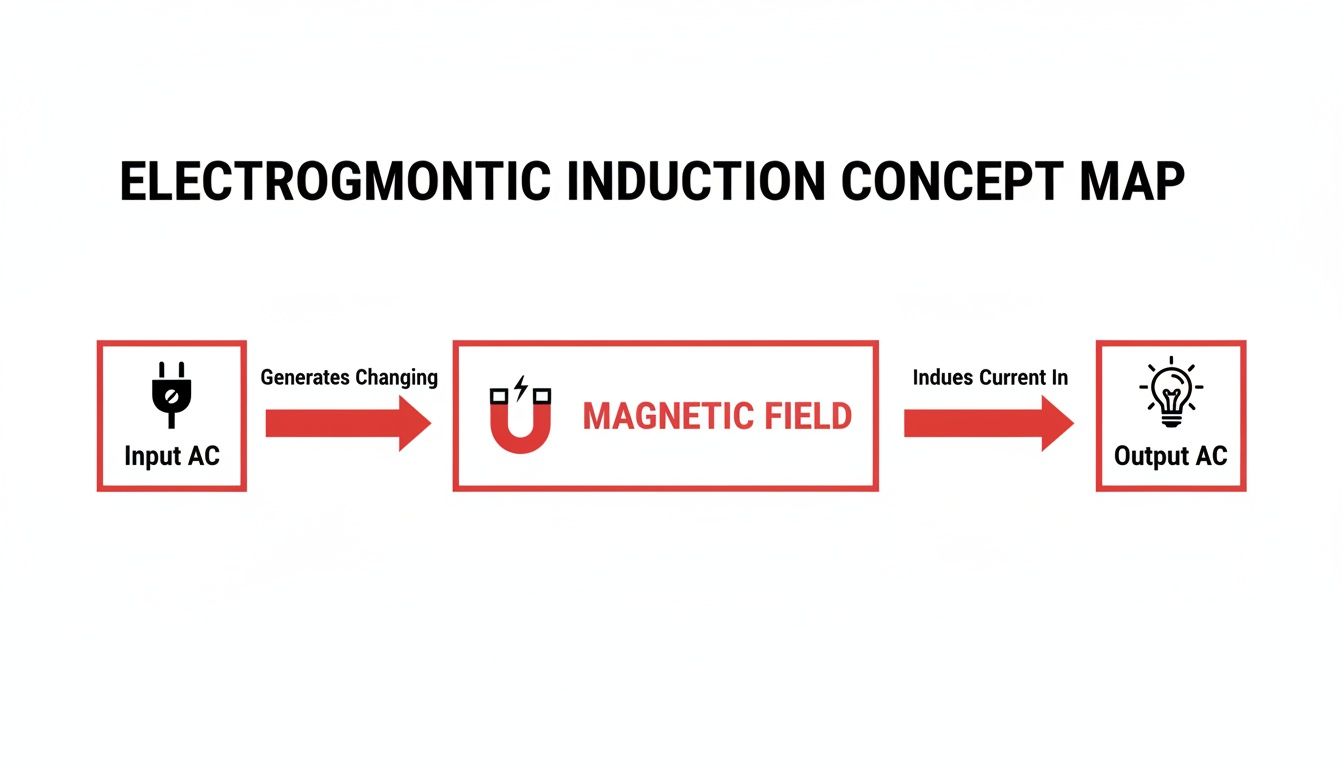
This visual shows that the energy transfer relies completely on that fluctuating magnetic field, a fundamental concept that applies whether the transformer is cooled by air or by oil.
The Case for Dry-Type Transformers
For indoor applications where safety is paramount—such as hospitals, data centers, high-rise commercial towers in Dubai, or residential buildings—dry-type is the superior choice. Their main advantage is fire safety. With no flammable liquid, they significantly reduce fire risk, making them ideal for areas with high human traffic or critical equipment.
This inherent safety allows them to be installed closer to the electrical load, which shortens secondary cable runs, reduces power losses, and lowers cabling costs on large projects. They are also lower maintenance, with no need for oil testing, filtering, or replacement, and no risk of environmentally damaging leaks.
When to Use Oil-Immersed Transformers
Oil-immersed transformers are the workhorses of the electrical industry, commonly found in utility substations and large industrial plants across the UAE. The mineral oil is a more efficient coolant than air, enabling these units to handle higher power ratings and dissipate heat more effectively.
This superior cooling allows them to be more compact than a dry-type transformer of the same KVA rating. While they present a fire risk and require a stricter maintenance schedule, their robustness, long lifespan, and cost-effectiveness at high voltages make them indispensable for the region's power grid. With UAE electricity demand growing by 6.5% annually, three-phase oil-immersed units are dominant. You can read the full research about these market trends for a deeper understanding.
Choosing the right type is a strategic decision impacting project safety, budget, and long-term operational costs. For any indoor or public-facing installation in the GCC, the fire safety and low maintenance of a dry-type unit from a supplier like GoSwitchgear is the superior choice.
A Head-to-Head Comparison for GCC Projects
Making the right call between these two transformer types is crucial, especially when you factor in the specific demands of projects in the UAE and KSA. This table lays out the key differences to help guide your decision.
Comparing Transformer Types for GCC Projects
| Parameter | Dry-Type Transformer | Oil-Immersed Transformer |
|---|---|---|
| Cooling Method | Air-cooled (natural or forced air) | Oil-cooled (mineral oil) |
| Typical Application | Indoors: Hospitals, data centres, commercial buildings, malls | Outdoors: Utility substations, industrial plants, large factories |
| Fire Safety | High: No flammable liquids, making it the safest option for indoor use. | Lower: Oil is flammable, requiring fire suppression systems and containment bunds. |
| Maintenance Needs | Low: Requires routine cleaning of coils and inspection of connections. | High: Needs regular oil sampling, testing, and potential filtering or replacement. |
| Environmental Risk | None: No risk of oil leaks or soil contamination. | Moderate: Leaks can cause environmental damage, requiring spill containment. |
| Efficiency & Size | Generally larger and slightly less efficient for the same rating. | More compact and efficient, especially at higher KVA ratings. |
| Installation Location | Can be installed close to the load, reducing cable costs. | Must be installed outdoors or in a dedicated, fire-rated vault. |
Ultimately, the environment dictates the choice. For populated, indoor spaces where safety and low maintenance are top priorities, dry-type is the logical and responsible option. For high-power, outdoor utility, and industrial applications where performance and durability are paramount, oil-immersed transformers remain the industry standard.
How to Select the Right Transformer Specifications
Choosing the correct step down transformer is a critical engineering decision that directly impacts the safety, efficiency, and longevity of an electrical system. For procurement teams and panel builders in the UAE, misinterpreting a datasheet can lead to costly delays, equipment failure, and significant safety hazards.
This guide provides a framework for navigating technical specifications to ensure the selected transformer is perfectly suited for your project, whether it's a data center in Jebel Ali or a new solar installation in Abu Dhabi.
Core Electrical Ratings
These three fundamental electrical parameters are the non-negotiable foundation of your selection process.
Voltage Ratings (Primary and Secondary): The primary voltage must match the utility supply (e.g., 11kV from a DEWA substation), and the secondary voltage must meet the equipment's requirements (e.g., 400V/230V for a commercial building).
KVA Capacity (Kilovolt-Ampere): This indicates the transformer's power handling capability. Conduct a thorough load analysis and add a 20-25% buffer to accommodate future growth and manage inrush currents from large motors. For a detailed methodology, see our guide on how to perform an electrical load calculation in our comprehensive guide.
Phase Type (Single vs. Three-Phase): Single-phase transformers are suitable for smaller residential or light commercial loads. However, for industrial machinery, large HVAC systems, and most commercial applications in the UAE, a three-phase step down transformer is the standard, providing balanced and reliable power.
Environmental and Physical Specifications for the GCC
The UAE’s climate—with its intense heat, high humidity, and airborne dust—places unique stress on electrical equipment. Overlooking these factors is a recipe for premature failure.
A transformer's datasheet is a performance contract. Verifying specifications like IP rating, cooling class, and efficiency is not just about compliance; it's about ensuring reliability in a region that pushes components to their limits.
Key specifications to scrutinize include:
IP (Ingress Protection) Rating: This two-digit code is crucial for durability in the GCC. The first digit rates protection against solids (dust), and the second against liquids (moisture). For dusty, outdoor, or industrial sites, an IP54 rating or higher is recommended to prevent internal contamination.
Cooling Class: This specifies how the transformer dissipates heat. Common classes include ONAN (Oil Natural Air Natural) for oil-immersed types and AN (Air Natural) for dry types. For high-capacity units or installations with poor ventilation, consider forced cooling options like ONAF (Oil Natural Air Forced).
Efficiency Rating: Modern transformers typically operate above 98% efficiency. A higher rating means less energy wasted as heat, resulting in lower electricity bills and reduced strain on cooling systems.
Ensuring Compliance and Reliability
The selected transformer must comply with all relevant local and international standards. The UAE's data centers and industrial hubs depend on reliable step down transformers for stable power, a key factor in the MEA transformer market's projected growth.
To ensure compliance and performance, confirm that the equipment meets:
- Local Utility Regulations: Adherence to guidelines from authorities like DEWA, ADDC, or SEWA is mandatory.
- IEC Standards: Look for compliance with key international standards, particularly IEC 60076 for power transformers.
By systematically evaluating these specifications, you can confidently select a transformer from a trusted supplier like GoSwitchgear that meets technical requirements and ensures reliable, long-term performance in the challenging GCC environment.
Best Practices for Safe Transformer Installation
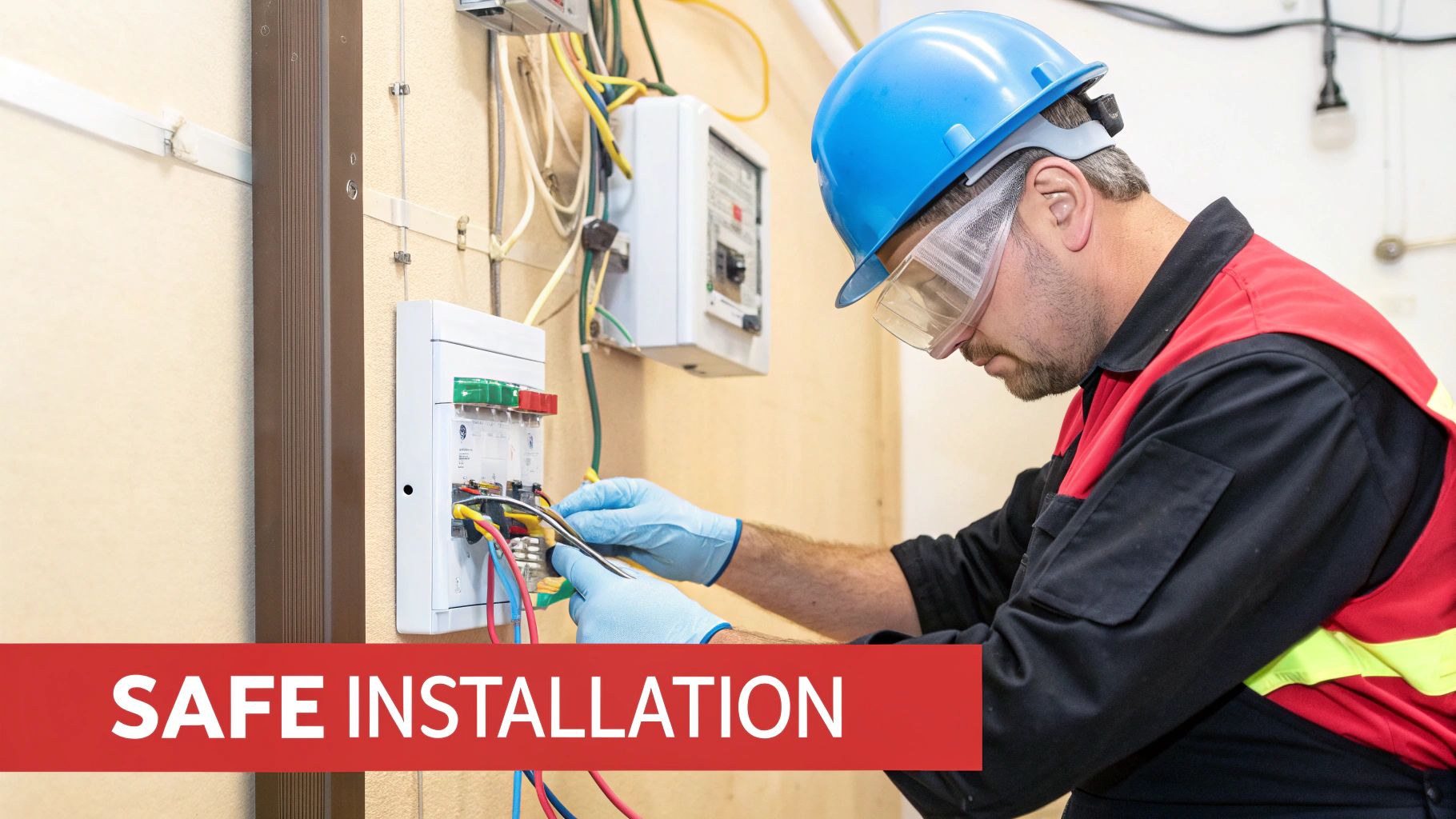
A perfectly specified step down transformer is only as reliable as its installation. For electricians and installation teams in the UAE, a methodical, safety-first approach is essential for ensuring long service life and preventing catastrophic failure.
Proper installation protects the equipment, the facility, and personnel. The process begins with selecting a suitable location that accounts for the environmental challenges of the GCC region.
Pre-Installation Checks and Site Preparation
A thorough site assessment is critical before the transformer is positioned. In high ambient temperatures like those in Dubai and Abu Dhabi, proper airflow is non-negotiable to prevent overheating, a leading cause of premature failure.
Ensure Adequate Ventilation and Clearance: Transformers require sufficient space for air circulation. Adhere to the manufacturer's specified minimum clearance distances and avoid enclosing the unit in a tight, unventilated space where heat can accumulate.
Verify Structural Support: The mounting surface, whether a concrete pad or structural steel, must be level and capable of supporting the transformer's full weight. Vibrations from improper mounting can cause connections to loosen over time.
Confirm Environmental Ratings: Double-check the transformer's IP rating to ensure it is suitable for the installation environment. A dusty industrial site requires a higher level of protection than a clean, indoor electrical room.
Grounding and Connection Procedures
Proper grounding (earthing) and secure connections are fundamental to a safe installation. Improper grounding can create lethal shock hazards, while loose connections generate heat, waste energy, and pose a serious fire risk. Adhere strictly to local utility codes, such as those from DEWA.
A common and dangerous mistake is using undersized cables for the secondary connections. When a step down transformer reduces voltage, it proportionally increases current. Failing to account for this higher amperage with correctly sized cables can lead to overheating, insulation melt, and potential electrical fires.
Torque all connections to the manufacturer's exact specifications to prevent them from loosening due to thermal cycling or mechanical vibration. This attention to detail is equally crucial for all low-voltage switchgear and power distribution components.
Commissioning and Final Safety Checks
Pre-commissioning tests are the final opportunity to identify issues before the system is energized.
- Insulation Resistance Test: Use a megohmmeter to check the insulation between windings and from windings to ground to detect any internal shorts or damage.
- Voltage and Phase Checks: After energizing, verify that the output voltage is within tolerance and that the phase rotation is correct for three-phase systems to prevent damage to motors.
- Final Inspection: Conduct a thorough visual walkthrough to ensure all connections, grounding points, and external components are secure and compliant.
This disciplined process ensures every installation is functional, safe, reliable, and capable of withstanding the region's operational demands. You can learn more about these market dynamics and future growth here.
A Practical Guide to Transformer Maintenance and Troubleshooting
Proper installation of your step down transformer is just the beginning. A proactive maintenance plan is essential to protect your investment and avoid unplanned downtime, a critical consideration for any facility manager or maintenance team in the UAE.
A consistent maintenance schedule is the key to achieving decades of reliable service, especially given the regional climate challenges of high heat and airborne dust. Regular checks allow teams to identify and address minor issues before they escalate into major failures, ensuring the efficiency of your entire electrical infrastructure.
Routine Maintenance Checklist
A structured maintenance approach ensures all critical points are checked. These practices apply to both dry-type and oil-immersed transformers.
- Visual Inspection (Monthly): Conduct a walk-around inspection to look for physical damage, signs of corrosion, or oil leaks on oil-immersed units.
- Cleaning (Quarterly): Dust accumulation acts as an insulator, trapping heat. Regularly clean cooling fins and vents to maintain optimal heat dissipation, which is critical in the high ambient temperatures of the UAE.
- Connection Integrity (Annually): Use a torque wrench to verify that all electrical connections are tightened to manufacturer specifications, as thermal cycling can cause them to loosen over time.
- Temperature Monitoring (Ongoing): Use an infrared thermometer to monitor operating temperatures under load. A sudden temperature spike can indicate an internal fault or overloading.
For more detailed schedules and best practices, our guide on planned preventative maintenance is an excellent resource.
Common Troubleshooting Scenarios
Even with diligent maintenance, issues can arise. This guide helps diagnose common problems with step down transformers.
| Symptom | Likely Cause(s) | Recommended Solution |
|---|---|---|
| Overheating | Poor ventilation, dust buildup on cooling surfaces, or simple overloading. | Improve the airflow around the unit, give it a thorough cleaning, and run a load analysis to see if it's undersized. |
| Unusual Humming/Buzzing | Loose core laminations, rattling hardware, or an overloaded condition. | Power it down and inspect for anything loose. If the noise is still there under a normal load, it's time to call the manufacturer. |
| Incorrect Output Voltage | Incorrect tap settings, an internal winding fault, or a problem with the incoming voltage. | First, check that the tap changer settings are correct. Then, verify the primary voltage to rule out a supply issue. |
A systematic approach to fault-finding saves time. Always start with the simplest potential causes, such as blocked vents, before proceeding to more complex internal diagnostics.
To enhance your team's diagnostic skills, explore resources on effective maintenance problem-solving strategies.
Powering Your Projects with the Right Partner
Selecting the right step down transformer is a strategic investment in your project's safety, efficiency, and long-term success. We have covered the essentials: from understanding transformer types and specifications to best practices for installation and maintenance. Now, it's time to apply this knowledge to your next project.
For engineers, panel builders, and procurement managers in the UAE and wider GCC, finding reliable electrical components UAE can supply is paramount. A great starting point is exploring the high-quality transformers available on the GoSwitchgear platform.
Your project’s success hinges on sourcing components that can withstand the demanding GCC climate. Partnering with a supplier who understands these local challenges ensures compliance, longevity, and peace of mind from day one.
If you are looking for an energy management solution Dubai projects can rely on, our team of experts is ready to provide tailored advice to guide your decisions. Contact our Dubai team to ensure your infrastructure is powered by equipment built for excellence and reliability.
Frequently Asked Questions
How Do I Calculate the Right KVA Rating for My Project?
To correctly size your transformer, first calculate the total power demand (in watts or amps) of all connected equipment. Convert this to KVA.
A best practice is to add a 20-25% capacity buffer. This accommodates future expansion and handles the initial inrush currents from motor startups without overloading the transformer. For complex projects with variable loads, consulting an electrical engineer is recommended to ensure precise sizing.
Is a Dry-Type or Oil-Filled Transformer Better for the UAE Climate?
The choice depends on the installation location. For any indoor application—such as commercial buildings, hospitals, or data centers—dry-type transformers are the preferred choice. Their oil-free design eliminates fire hazards, making them safer for enclosed, populated spaces.
For large outdoor substations or industrial applications, oil-immersed transformers are often more practical due to their superior cooling efficiency and cost-effectiveness at high KVA ratings. However, they require more rigorous maintenance to perform reliably in the UAE's heat.
What Are the Key Regulations for Transformer Installation in the UAE?
In the UAE, all transformer installations must comply with the strict standards set by the local utility authority, such as DEWA in Dubai or ADDC in Abu Dhabi.
These regulations cover critical aspects like proper earthing, cable sizing, minimum clearance distances, and required protection devices. To ensure a safe, compliant, and approved installation, it is mandatory to work with a certified electrician who is knowledgeable about the latest local codes and guidelines.
For robust and reliable step down transformers designed for the demands of the GCC climate, trust GoSwitchgear. Explore our extensive range of electrical components to power your next project.
Browse our complete catalogue of transformers at GoSwitchgear
Share this post

Related
Posts
A Guide to Choosing AC to DC Converters for UAE & GCC Electrical Systems
Master AC to DC converters with this comprehensive guide for engineers in the UAE & GCC. Learn selection, installation, and...

A Guide to Drill Machine Prices in the UAE for Technical Professionals
Find the best drill machine price in UAE. Our 2026 guide helps contractors and engineers choose the right corded, cordless,...
A Professional’s Guide to Choosing AGM VRLA Batteries in the UAE Climate
Discover why AGM VRLA batteries are the superior power solution for UPS, solar, and industrial systems in the UAE. Get...
How to Choose the Right Lithium Ion Battery Charger for UAE & GCC Projects
Discover how to select the right lithium ion battery charger for UAE projects. This guide covers specs, BMS integration, and...
.jpg)