
.jpg)

Posted by:
Category:
Comments:
Post Date:
Selecting the Right PVC Trunking Sizes: A Guide for UAE & GCC Projects
Choosing the correct PVC trunking sizes is more than a minor detail—it's a critical decision impacting the safety, efficiency, and regulatory compliance of electrical projects across the UAE. For an engineer in Dubai or a panel builder in Abu Dhabi, a miscalculation here leads to overcrowded cables, a significant fire risk in the intense GCC climate, and costly rework.
This guide provides practical, solution-focused insights to help you specify the right trunking, ensuring your installations are safe, compliant with local standards, and prepared for future demands.
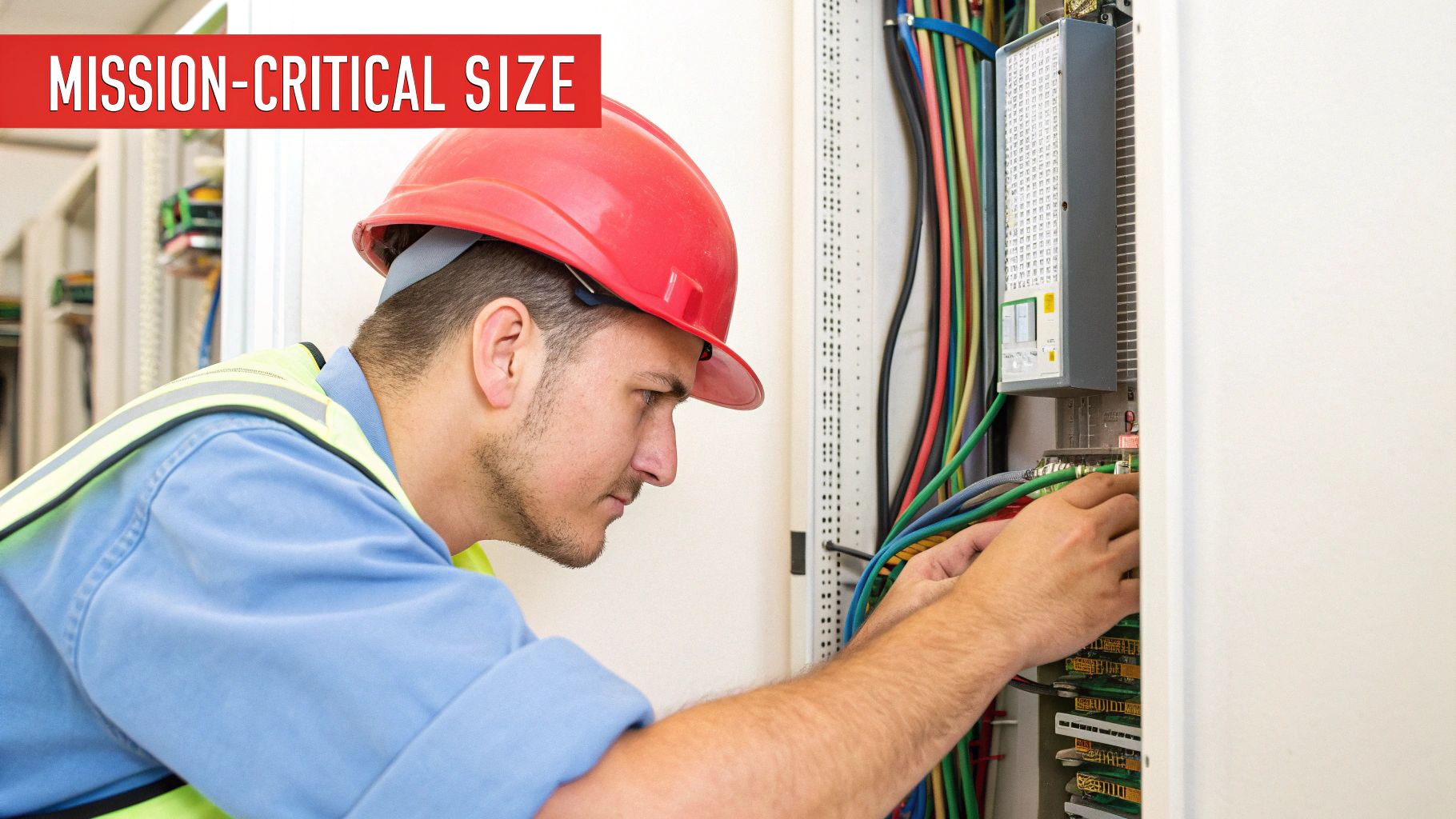
Why Your PVC Trunking Size is Mission-Critical for GCC Installations
Frankly, selecting the correct PVC trunking size is a strategic move. It's what keeps your project on schedule, ensures you meet local standards like those from DEWA, and protects the long-term health of your electrical systems. This simple choice elevates cable management from an afterthought to a core part of a truly professional installation, especially when dealing with the environmental challenges of heat and dust in the UAE and KSA.
Making the right call from the outset is essential for both immediate performance and any future expansion plans.
Key Factors Influencing Your Choice
The process goes well beyond just guesstimating the number of cables you need to run. Several technical factors come into play, especially for projects across the UAE and KSA where demanding environmental conditions are the norm.
Here’s what you need to be thinking about:
- Cable Capacity and Fill Ratio: There’s an industry standard for a reason: a 45% maximum fill ratio. This isn't just a friendly suggestion; it's vital for allowing air to circulate and dissipate heat. This prevents the cable insulation from degrading and, just as importantly, leaves you room for future additions without having to rip everything out and start over.
- Cable Type and Bending Radius: Different cables have minimum bending radii to prevent signal loss or physical damage. If your trunking is too small, you're forced to make sharp bends at corners, which can easily compromise the cable's integrity. This is especially critical when you're working with sensitive data or fibre optic cables.
- Future-Proofing Your Installation: One of the most common mistakes is sizing trunking only for the cables you need today. A smart installer always plans for tomorrow. Allocating an extra 20-25% capacity is a solid best practice that will save you a world of headaches, time, and money down the line when expansions are needed.
For any electrical contractor in the GCC, ignoring proper trunking size isn't just poor practice—it's a direct risk to asset safety and operational continuity. A well-planned cable management system is the backbone of a reliable electrical infrastructure.
At GoSwitchgear, we provide a wide range of IEC-compliant PVC trunking designed to meet the rigorous demands of projects throughout the region.
Navigating Standard Trunking Dimensions in the GCC
If you're an engineer or electrician in Dubai, you know that picking the right PVC trunking size is a daily drill. It might seem basic, but getting it right is the difference between a clean, compliant installation and a messy, problematic one. Instead of just rattling off a list of sizes, let’s look at how the most common dimensions are actually used on projects across the UAE.
Take the smaller sizes, for example. The 25x25mm trunking is the absolute go-to for intricate control wiring inside tight electrical panels. It’s perfect for keeping those low-voltage signal and control cables organized without eating up valuable real estate.
Common Sizes for Commercial and Industrial Use
As soon as you move into larger commercial buildings, your trunking needs scale up. The 40x40mm is a real workhorse, ideal for running cables to lighting fixtures, power outlets, and building management systems. When you're dealing with mixed runs of power and data cables, the 50x50mm size is often the default choice, giving you just enough room to keep everything separated and avoid interference.
You don't just have to take my word for it. Market trends back this up, showing that PVC consumption in the UAE hit around 250,000 tons in 2024, a noticeable jump from 220,000 tons back in 2019. Those go-to PVC trunking sizes—25x25mm, 40x40mm, and 50x50mm—are found in over 60% of commercial projects. They’re just the right fit for the typical cable bundles needed for things like energy monitoring and process control. You can dig deeper into these numbers in the full report from Research and Markets.
When you get into more heavy-duty applications, that's when the big guns come out. A 100x50mm or 100x100mm trunking is usually reserved for the main power distribution arteries—think high-rise towers, industrial plants, or large-scale solar projects where you’re pulling thick, heavy-gauge cables.
Pro Tip for Procurement Teams: Always, and I mean always, check the internal dimensions of the trunking you're ordering. The listed external size can be deceiving. What really matters is the usable space inside, especially when you need to meet that critical 45% fill ratio for proper heat dissipation in the hot GCC climate.
To make things a bit easier for your next project in Abu Dhabi or Dubai, I've put together a quick-reference table. It matches standard trunking sizes with their common applications and a rough idea of how many cables they can hold.
Common PVC Trunking Sizes and Their Applications
This table is a great starting point for matching the right trunking to the job at hand.
| Trunking Size (mm) | Typical Application | Approx. Cable Capacity (e.g., Cat6) | Common Project Type |
|---|---|---|---|
| 25x25 | Control panel wiring, single circuit runs | 8–10 Cables | Small machinery, residential |
| 40x40 | General commercial wiring, multiple circuits | 20–25 Cables | Office fit-outs, retail stores |
| 50x50 | Mixed power and data cable runs | 35–40 Cables | Commercial buildings, data closets |
| 100x50 | Sub-main distribution, vertical risers | 70–80 Cables | High-rise buildings, workshops |
| 100x100 | Main power distribution, heavy cable consolidation | 150+ Cables | Industrial plants, solar PV farms |
Keep this handy, and it should help streamline your selection process and ensure your installations are both practical and compliant.
Calculating Your Required Trunking Capacity
Sizing your trunking correctly isn't about guesswork. It’s a straightforward calculation, and the magic number you need to know is 45%. This is the industry standard across the GCC, and it's a non-negotiable rule for safety. It simply means your cables should never take up more than 45% of the trunking's internal space.
Why is this so critical, especially here in the UAE? It's all about the heat. The 45% fill ratio guarantees enough free air inside the trunking for heat from the cables to dissipate properly. Skimp on this, and you're risking insulation breakdown and creating a serious fire hazard. Plus, it gives you that much-needed breathing room to add more cables down the line without ripping everything out.
The Calculation Process
To figure out the right trunking size, you just need to follow a few simple steps. The first thing to do is get a complete list of every single cable you plan to run through one section of trunking.
Next, you'll need the overall diameter for each type of cable. Don't just measure the copper core; you need the full diameter, including all the insulation and the outer sheath. This info is always available on the manufacturer's datasheet.
Once you have the diameters, you can find the cross-sectional area (CSA) for each cable using the classic formula for a circle's area: Area = π × (Diameter / 2)². Add up the areas for all your cables to get the total CSA for the whole bundle. From there, you just apply the fill factor to find the minimum internal area your trunking needs.
This graphic gives a great visual of how trunking size scales with the job.
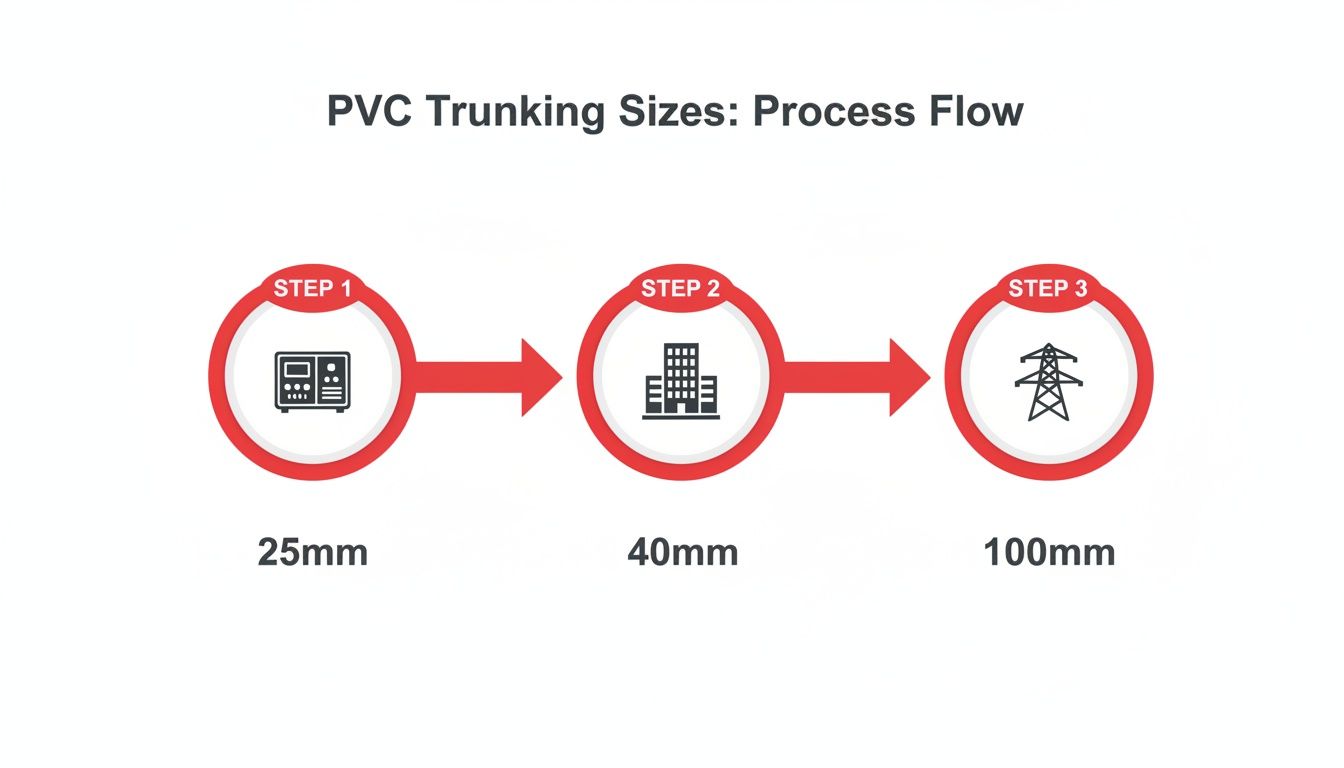
You can see the progression: smaller 25mm for things like control panels, up to 40mm for commercial buildings, and then the heavy-duty 100mm for major infrastructure. It’s a perfect illustration of how trunking capacity has to match the project's complexity.
A Real-World Dubai Project Example
Let's make this practical. Imagine you're wiring an HVAC control panel for a new commercial tower in Dubai. Your cable schedule looks something like this:
- 10x 1.5mm² control cables (Overall Diameter = 3.0mm each)
- 5x 2.5mm² power cables (Overall Diameter = 3.5mm each)
- 2x Cat6 data cables (Overall Diameter = 6.0mm each)
First, we'll calculate the area for a single cable of each type. Remember, we use the radius (Diameter / 2).
- Control Cable Area: π × (1.5mm)² = 7.07 mm² per cable
- Power Cable Area: π × (1.75mm)² = 9.62 mm² per cable
- Data Cable Area: π × (3.0mm)² = 28.27 mm² per cable
Now, let's get the total area for the entire bundle you're running.
- (10 cables × 7.07 mm²) + (5 cables × 9.62 mm²) + (2 cables × 28.27 mm²) = 175.39 mm²
Finally, we apply our 45% rule to find the minimum trunking area we need.
- Minimum Trunking Area = Total Cable Area / 0.45
- Minimum Trunking Area = 175.39 mm² / 0.45 = 389.76 mm²
Based on this calculation, a standard 25x25mm PVC trunking (with an internal area around 529mm²) is the right choice. It easily covers our minimum requirement and leaves a healthy 26% of extra space for any future additions—that’s smart, compliant work.
Common Sizing Mistakes That Cost Time and Money
Even seasoned electricians on a hectic job site can make simple errors with pvc trunking sizes. These aren't catastrophic engineering failures, but small, practical oversights that end up causing expensive rework and frustrating delays. They disrupt the workflow and can seriously compromise the quality of the final install.
One of the most frequent slip-ups? Underestimating the final cable count. A project's scope can shift on a dime, and if you don't leave enough space for those last-minute additions, you’re looking at a complete do-over. The golden rule is to always plan for more capacity than you think you need right now.
Another classic mistake is forgetting about the cable's bending radius, especially when you hit a corner. A trunking size that seems perfect for a long, straight run might be way too tight for a 90-degree turn. This forces sharp, damaging bends in your cables, which is a clear violation of installation standards.
Critical Errors and How to Solve Them
Let's break down the most common problems we see on sites across Dubai and Abu Dhabi and talk about straightforward solutions to keep your projects running smoothly.
Forgetting Future Growth: This is the big one. It's incredibly common to install trunking that's perfect for today's needs but leaves zero room for tomorrow's expansion.
- Solution: Before you order a single piece of material, create a detailed cable schedule. Then, add a 25% buffer to your final calculation. This simple step future-proofs the installation and saves major headaches down the line.
Ignoring Cable Segregation: Just stuffing power and data cables into the same compartment is a recipe for disaster. You're basically inviting electromagnetic interference (EMI) to wreck your network performance.
- Solution: Use segregated trunking that has built-in dividers. If that's not an option, run completely separate trunking paths for power and data lines. It's the only way to maintain signal integrity.
Choosing the Wrong Material for the Climate: In the intense UAE heat, standard PVC just doesn't cut it. When exposed to constant UV radiation, it will become brittle and eventually crack.
- Solution: For any installation that's outdoors or exposed to the sun, you absolutely must use UV-stabilized PVC trunking with a high IP rating to protect against dust and moisture. This is non-negotiable if you want the installation to last.
In Dubai's fast-paced construction scene, 50x50mm PVC trunking really took off after 2020, showing up in 42% of new control panel builds. At the same time, we saw imports of 25x40mm mini-trunking jump by 28% between 2018-2024 as facility managers started retrofitting older buildings for smart energy monitoring. You can dig deeper into these regional PVC market trends in this industry report.
When Standard Trunking Just Won't Cut It: Specialized GCC Applications
While your typical commercial fit-out has pretty straightforward requirements, many projects across the UAE and the wider GCC throw unique curveballs. These demand specialized cable management that goes far beyond generic PVC trunking sizes.
When you're dealing with high-performance or sensitive applications, you have to think beyond basic capacity. It's a whole different ball game that requires careful planning around specific environmental and technical challenges.
Solar PV and Heavy-Duty Installations
Take the renewable energy sector, especially solar PV farms. We're not talking about standard wiring here. These installations use heavy-gauge DC cables to move serious current from the panels to the inverters. You need larger, more robust trunking to handle the load and, just as importantly, to dissipate heat under our intense GCC sun.
For these kinds of jobs, you should be looking at trunking in the 150x100mm range or even bigger. And don't forget the material spec. It's absolutely crucial to use UV-stabilized PVC to stop it from going brittle and failing early—a common problem we see in this climate.
Data Centers and Industrial Control
In a data center or an advanced industrial facility in Dubai, electromagnetic interference (EMI) is the enemy. Simply running power and data cables side-by-side without proper shielding is a recipe for disaster. It can corrupt sensitive signals, leading to costly system downtime.
This is where segregated trunking is a non-negotiable. This isn't just a bigger box; it has a built-in divider that creates physically separate channels for power and low-voltage data cables. It’s a single containment system that guarantees signal integrity.
In mission-critical facilities, relying on standard trunking for mixed cabling is a significant risk. The modest upfront cost of segregated trunking is negligible compared to the potential cost of data loss or operational disruption caused by EMI.
Environments Requiring Halogen-Free Solutions
Safety regulations are strict for a reason. In places like public buildings, tunnels, or areas packed with sensitive electronics, low smoke zero halogen (LSZH) materials are often mandated. Why? Because if a fire breaks out, standard PVC releases toxic halogen gases and thick, blinding smoke.
Halogen-free trunking is engineered to prevent this. When exposed to fire, it emits very little smoke and no toxic fumes. Specifying this material is not just about meeting safety codes; it's about protecting people and critical assets. At GoSwitchgear, we provide the expert guidance needed to make sure you select the right components for every job, from standard commercial projects to the most complex industrial installations in the UAE.
Your Partner for Reliable Cable Management
Let’s summarize the key takeaways. When it comes to project success here in the UAE, getting your PVC trunking sizes right isn't just a detail—it's everything. Stick to that 45% fill ratio as your golden rule for safety and future-proofing, and never underestimate the demanding GCC climate. It's what separates a reliable, long-term installation from one that fails prematurely.
At GoSwitchgear, we're not just another supplier of electrical components in the UAE. Think of us as your partners on the ground. We have a deep-seated understanding of the unique challenges this region throws at electrical systems, which is why our entire catalogue of PVC trunking is IEC-compliant and built specifically for our environment.
Our mission is to arm engineers, electricians, and panel builders with the exact components they need to build safe, efficient, and resilient installations. Every single time.
Choosing a partner who gets the regional specifics—from the intense heat and humidity to the local utility standards—is the first real step toward a successful outcome. We’ve got the expertise and the inventory to back you up.
Ready to spec out the right trunking for your next job? You can explore our complete range of PVC trunking solutions on GoSwitchgear. And if you need advice tailored to your project or a competitive quote, contact our expert teams in Dubai and Abu Dhabi. Let’s make sure your cable management is truly built to last.
Your PVC Trunking Questions, Answered
When you're on the job, you run into all sorts of practical questions. Let's tackle some of the most common ones we hear from engineers and electricians about using PVC trunking here in the UAE and the wider GCC region.
What's the Big Deal with the 45% Fill Ratio?
You've probably heard about the 45% fill ratio. It's not just a suggestion—it's a critical standard that dictates your cables shouldn't take up more than 45% of the space inside the trunking.
Why does this matter so much in the UAE? It's all about the heat. Our climate puts immense stress on electrical systems. Leaving that extra space allows for crucial air circulation, which helps dissipate the heat generated by the cables. This simple rule prevents cable insulation from breaking down prematurely and is fundamental to the long-term safety and reliability of your installation.
Can I Run Power and Data Cables in the Same Trunking?
It's a common temptation to save space and time, but you really shouldn't. Running power and data cables side-by-side in a standard trunking is asking for trouble. You'll likely encounter electromagnetic interference (EMI), where the power cables disrupt your data signals, leading to poor network performance.
If you absolutely must run them in the same pathway, the only proper way is to use segregated trunking. This type has a built-in divider that creates a physical barrier between the cable types, ensuring your data signal integrity is maintained.
Do I Need Special Trunking for Outdoor Jobs in Dubai?
Yes, without a doubt. The intense sun in Dubai will wreak havoc on standard indoor PVC. For any outdoor installation, you need to specify trunking that is UV-stabilized. This treatment prevents the plastic from becoming brittle and cracking under constant sun exposure.
On top of that, look for a suitable IP (Ingress Protection) rating. This ensures the trunking can effectively protect your cabling from the fine dust and occasional moisture that are part of our regional environment.
For a complete range of IEC-compliant cable management solutions built to handle the demanding GCC climate, check out the full catalogue at GoSwitchgear.
Share this post

Related
Posts
A Guide to Choosing AC to DC Converters for UAE & GCC Electrical Systems
Master AC to DC converters with this comprehensive guide for engineers in the UAE & GCC. Learn selection, installation, and...

A Guide to Drill Machine Prices in the UAE for Technical Professionals
Find the best drill machine price in UAE. Our 2026 guide helps contractors and engineers choose the right corded, cordless,...

A Professional’s Guide to Choosing AGM VRLA Batteries in the UAE Climate
Discover why AGM VRLA batteries are the superior power solution for UPS, solar, and industrial systems in the UAE. Get...
How to Choose the Right Lithium Ion Battery Charger for UAE & GCC Projects
Discover how to select the right lithium ion battery charger for UAE projects. This guide covers specs, BMS integration, and...
.jpg)