
.jpg)


Posted by:
Category:
Comments:
Post Date:
Selecting the Right PVC Trunking Size: A Guide for UAE & GCC Professionals
Choosing the correct PVC trunking size is a critical decision for any electrical project in the UAE and wider GCC. For engineers, electricians, and panel builders, this choice is foundational to ensuring a safe, efficient, and compliant installation. Get it wrong, and you risk overheating, code violations, and future maintenance headaches. Common sizes range from a slim 25x16mm for single cable runs up to a robust 100x100mm for high-density industrial control panels.
Matching the trunking size to the cable load isn't just best practice—it's essential for performance and safety in our demanding climate.
Your Essential Guide to PVC Trunking Sizes in the GCC
As an engineer or panel builder here in the UAE, selecting the right PVC trunking size dictates the success, safety, and scalability of your project. This decision directly impacts cost, installation efficiency, and compliance with regional standards.
A properly sized trunking system does more than conceal wiring. It provides crucial mechanical protection, prevents dangerous overheating by allowing for heat dissipation, and ensures your installation meets the stringent requirements of local authorities like DEWA.
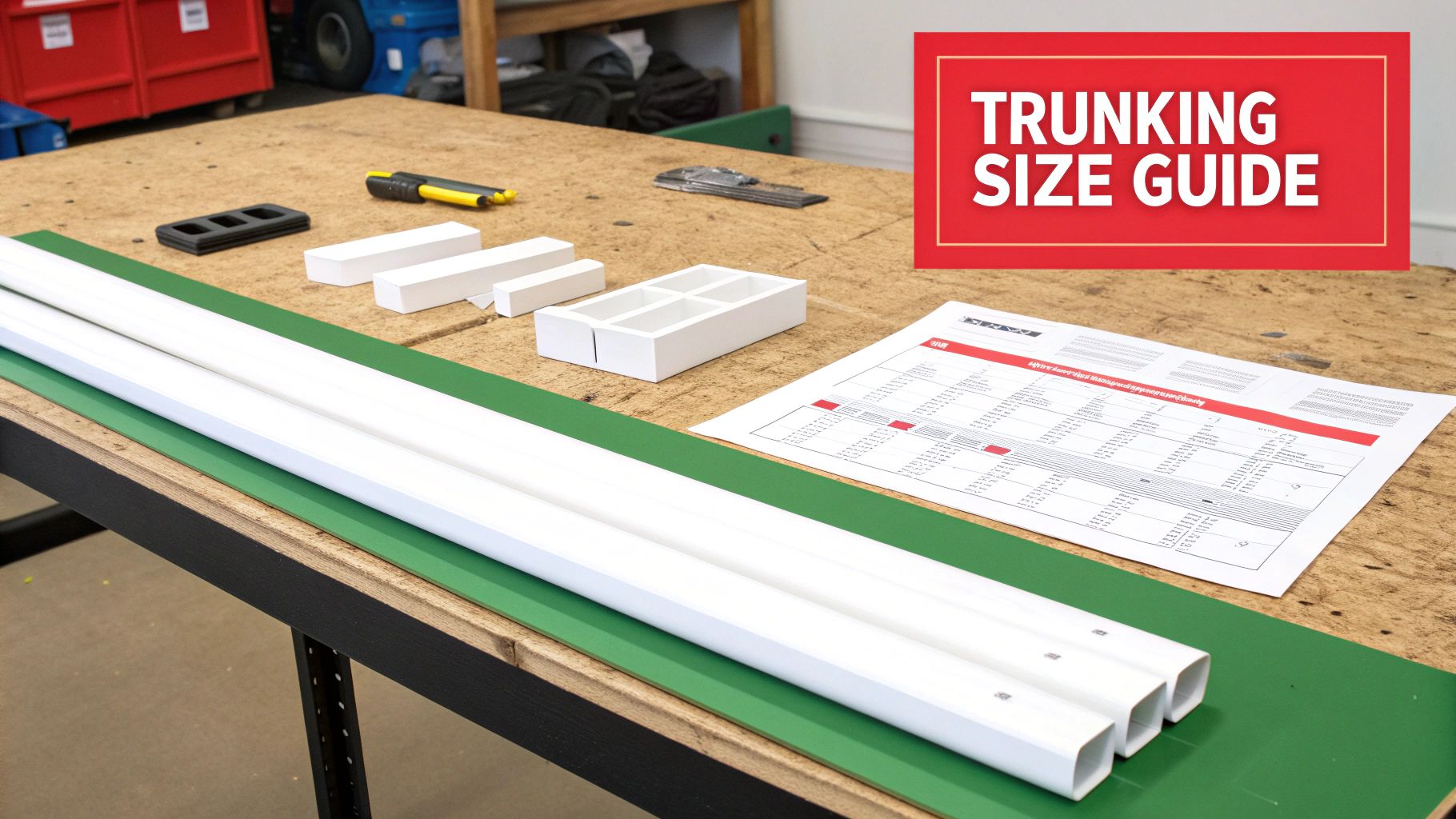
This guide provides a practical framework for projects in Dubai, Abu Dhabi, and across the GCC. Understanding common dimensions and their applications is the first step to leveraging the full benefits of PVC trunking by ensuring the system is specified correctly from the outset.
Quick Reference PVC Trunking Size and Application Chart
This table provides a high-level overview of common trunking sizes used on projects throughout the region and their typical applications. It serves as an excellent starting point for initial project scoping.
| Trunking Size (mm) | Typical Application | Example Cable Capacity (Approx.) |
|---|---|---|
| 25x16mm | Single lighting circuits, alarm wiring, network cables. | 4-6 x 1.5mm² T&E cables |
| 40x25mm | Small power circuits, multiple data cables in offices. | 8-10 x 2.5mm² T&E cables |
| 50x50mm | General commercial wiring, multiple socket outlets. | 15-20 x 2.5mm² T&E cables |
| 100x50mm | Sub-main distribution, high-density control panel wiring. | 30-40 x 2.5mm² T&E cables |
| 100x100mm | Main power distribution, feeder cables in industrial settings. | 60-75 x 4.0mm² single-core cables |
While this chart offers a solid baseline, a precise and compliant installation always requires a formal cable fill calculation, which we will address in detail.
Common Trunking Dimensions and Applications
Let's break down these sizes into practical categories to simplify the selection process for your UAE-based projects.
Small Sizes (e.g., 25x16mm, 40x25mm): These are the go-to solutions for low-voltage and light-duty applications. Ideal for running data cables to an office workstation, wiring a single lighting circuit, or connecting an alarm system in a residential villa. They are discreet and efficient for contained cable runs.
Medium Sizes (e.g., 40x40mm, 50x50mm): This range offers excellent versatility, making it a staple for commercial and retail environments. These sizes are well-suited for handling multiple power circuits, providing a good balance between cable capacity and spatial footprint on walls or in ceiling voids.
Large Sizes (e.g., 100x50mm, 100x100mm): For high-density cabling requirements, these larger profiles are essential. They are specified for main power distribution lines, sub-main circuits, and complex wiring within industrial control panels where numerous cables must be safely managed.
Why Getting Trunking Size Right is a Big Deal in the GCC Climate
Here in the UAE and across the GCC, choosing the right PVC trunking size is not just about containment. It is a critical safety decision that impacts the reliability and lifespan of the entire electrical installation. The region's unique challenges—intense heat, humidity, and dust—make accurate sizing non-negotiable for any professional project.
Attempting to reduce costs by specifying undersized trunking introduces a significant fire hazard. When cables are crammed together without adequate space for air circulation, the heat they generate becomes trapped. In the high ambient temperatures of a Dubai summer, this can lead to the thermal degradation of cable insulation, resulting in short circuits and potential fires.
Keeping Cool and Staying Compliant
The primary engineering reason for correct trunking sizing is to manage heat dissipation. All current-carrying conductors generate heat, and our climate exacerbates this effect. An undersized trunking run acts as an insulator, accelerating the aging of cable insulation and compromising its dielectric strength.
This is precisely why authorities like the Dubai Electricity and Water Authority (DEWA) enforce strict adherence to cable derating factors and fill ratios. These regulations are not bureaucratic hurdles; they are practical measures designed to mitigate thermal stress on electrical systems operating in our challenging environment.
By ensuring sufficient air volume around conductors, you facilitate natural convective cooling. This airflow is vital for maintaining the operational integrity of the wiring and ensuring a safe, long-lasting installation.
Finding the Sweet Spot Between Cost and Future Needs
Conversely, consistently over-specifying trunking is not a viable strategy. While it resolves heat dissipation concerns, it leads to material waste, increased project costs, and inefficient use of space within control panels and along cable routes. The professional approach is to find a balance: select a PVC trunking size that safely accommodates the current cable load while providing a practical margin for future expansion, without being excessively oversized.
The region's construction boom has increased demand for correctly specified electrical components. In the UAE, standard sizes like 25x40mm for residential wiring and 100x100mm for switchgear panels are prevalent. For contractors in Dubai and Abu Dhabi, adhering to compliant sizes streamlines installations and regulatory approvals. For a market overview, see this analysis of the Middle East & Africa PVC Trunking segment. Ultimately, accurate sizing is the hallmark of a professional who designs and builds installations engineered for the real-world demands of the GCC.
Mastering the Cable Fill Calculation
Transitioning from estimation to precise calculation for PVC trunking size is a core competency for any electrical engineer or panel builder. This process is governed by a fundamental rule for safety and compliance: never fill trunking to its maximum physical capacity.
This foresight prevents overheating and provides critical capacity for future system modifications or additions, saving significant time and expense over the installation's lifecycle.
The 45% Fill Factor Rule
Industry best practice, and a common regulatory requirement in the UAE, dictates that cables should occupy no more than 45% of the trunking's internal cross-sectional area. This is not an arbitrary figure. The remaining 55% of unoccupied space is essential for air circulation, allowing the heat generated by conductors to dissipate effectively.
Adherence to this rule is critical, particularly given the high ambient temperatures across the GCC. Ignoring it can lead to cumulative heat buildup and premature failure of cable insulation, posing a serious safety risk.
The 45% fill factor is your primary defence against thermal stress. It ensures the long-term reliability of your electrical system and prevents overheating that can compromise an installation, especially during peak summer months in Dubai.
The image below illustrates the risks associated with incorrect sizing, from creating safety hazards to wasting project funds.
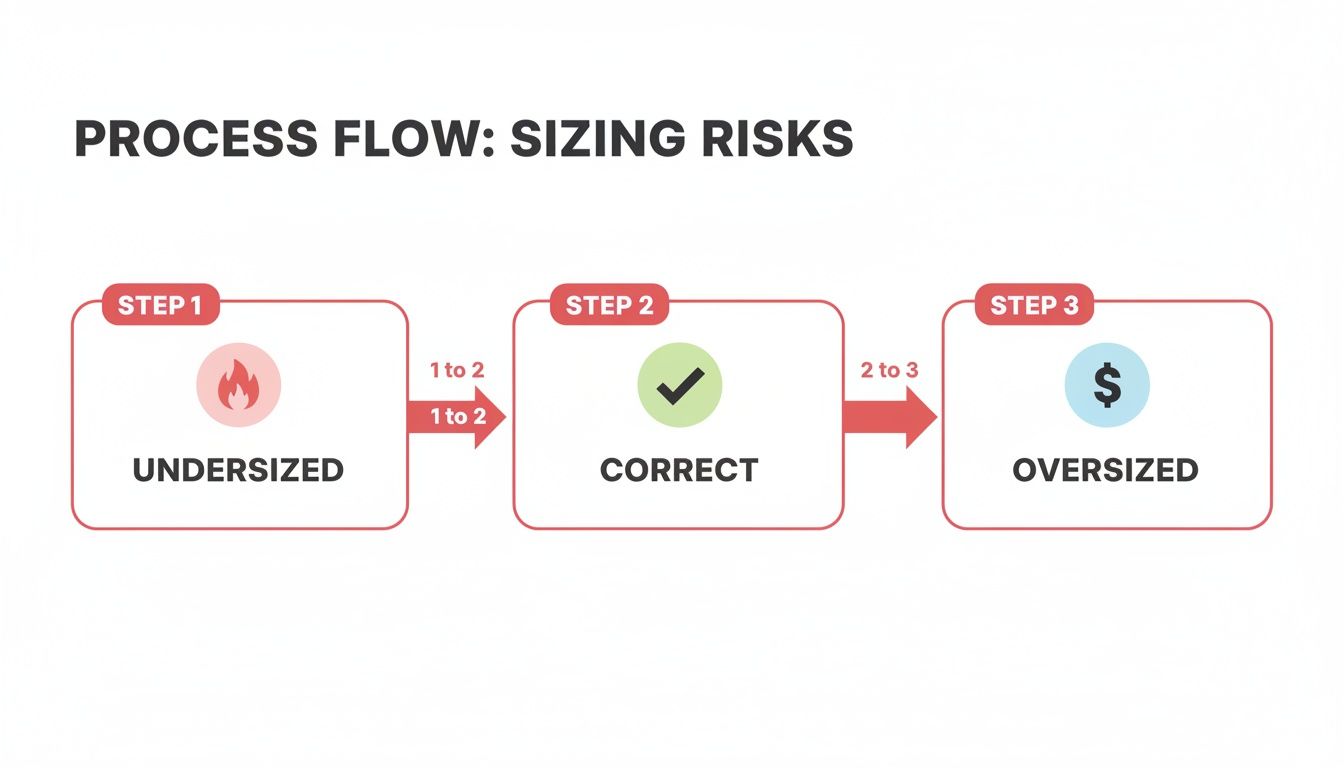
As demonstrated, correct sizing is the only method to guarantee a safe, cost-effective installation that balances current requirements with future needs.
Step-by-Step Calculation Guide
Determining the appropriate PVC trunking size is a straightforward process when approached methodically.
- Identify All Cables: Compile a complete list of all cables to be routed through the trunking section, specifying the quantity and size of each (e.g., 10 x 2.5mm², 5 x 4.0mm²).
- Find the Cable Cross-Sectional Area (CSA): Refer to the manufacturer’s datasheets to find the overall CSA for each cable type. This value, typically in mm², includes the conductor and all insulation layers.
- Calculate the Total Cable Area: Multiply the CSA of each cable type by the quantity of those cables. Sum these values to determine the total cross-sectional area required by all cables.
- Apply the 45% Fill Factor: Divide the total cable area by 0.45. The result is the minimum internal cross-sectional area your trunking must provide.
- Select the Right Trunking: Consult a PVC trunking datasheet (such as those available from GoSwitchgear). Choose a trunking size with an internal area equal to or slightly greater than your calculated minimum requirement.
For a more detailed analysis of this topic, please refer to our guide on managing cables in trunking. This systematic approach ensures every installation is optimally sized, compliant, and engineered for longevity.
Choosing the Right Trunking Profile for Your Project
While selecting the right pvc trunking size is fundamental, choosing the appropriate profile is equally important for a professional and functional installation. The profile dictates how cables are managed within the raceway, making it a critical decision for electricians and panel builders across the UAE.
Different profiles are engineered for specific applications. Using a solid-wall profile for a simple point-to-point run is ideal, but applying the same profile within a complex control panel would be impractical and inefficient. The choice of profile directly impacts organization, ease of maintenance, and long-term system reliability.
Standard Rectangular Trunking
This is the most common profile used in commercial and residential projects across Dubai and Abu Dhabi. Often referred to as maxi-trunking in larger dimensions, it provides a fully enclosed raceway for routing cables along walls, ceilings, or under raised floors.
Its primary benefit is robust mechanical protection against dust, moisture, and physical impact. For straightforward applications requiring cable containment between two points with minimal breakouts, standard rectangular trunking is the optimal solution.
Slotted Trunking for Control Panels
For control panel assembly, slotted trunking (or panel trunking) is an indispensable component. This profile features "fingers" and slots along its sides, allowing individual wires to be neatly routed out of the trunking and terminated directly onto components such as terminals, relays, or PLCs on the DIN rail.
This design offers several key advantages within a panel:
- Enhanced Organization: It transforms chaotic wiring into a structured, easily traceable layout.
- Improved Airflow: The slots facilitate air circulation around conductors, aiding in heat dissipation.
- Simplified Troubleshooting: Technicians can easily trace wires from a terminal back to their origin within the trunking, significantly reducing maintenance time.
Floor and Specialized Trunking Profiles
Specialized profiles are available for unique installation environments. Floor trunking, for example, features a durable, low-profile, and often rounded lid designed to withstand foot traffic in offices and retail spaces, enabling the safe routing of power and data across open areas.
For more demanding environments like industrial sites or outdoor areas, more robust solutions are necessary. Products like a durable electrical wire cover cable ramp are specifically engineered to protect cables from vehicular traffic and extreme mechanical stress.
To assist in selection, a comparison of common profiles is provided below.
Comparing Common PVC Trunking Profiles and Sizes
This table outlines the key characteristics of each profile, helping you specify the correct product for your application in the GCC region.
| Trunking Profile | Common Sizes (mm) | Primary Application | Key Features |
|---|---|---|---|
| Standard (Maxi) | 25x16, 40x25, 50x50, 75x50, 100x50, 100x100 | General purpose wiring in commercial, residential, and industrial buildings. | Solid, enclosed walls for maximum cable protection; snap-on or screw-on lids. |
| Slotted (Panel) | 25x40, 40x40, 40x60, 60x60, 80x80 | Control panels, switchgear assemblies, and automation cabinets. | "Fingers" and slots for easy wire breakouts; improves organization and airflow. |
| Floor Trunking | 50x12, 75x18, 90x20 | Routing cables across floors in offices, retail spaces, and public areas. | Low-profile, often curved or chamfered lid to prevent tripping; high durability. |
Each profile is designed for a specific purpose. Making the correct selection at the design stage saves time, reduces costs, and prevents future complications.
Matching the product profile to the application is essential. Utilizing slotted trunking in a control panel is a best practice that delivers significant returns in safety, serviceability, and operational excellence.
Familiarity with these profiles enables all stakeholders, from procurement teams to design engineers, to specify the exact components required for a clean, compliant, and robust installation. While trunking is ideal for fixed installations, learn how PVC electrical conduit offers flexible protection for different scenarios.
Installation Best Practices and Common Mistakes
Specifying the correct PVC trunking size is the first step; flawless installation is what ensures the system's performance and longevity. For electricians and installers in the UAE, executing this phase perfectly is critical, given the harsh environmental conditions.
A professional installation not only appears clean and orderly but also performs reliably, minimizing costly callbacks and rework.
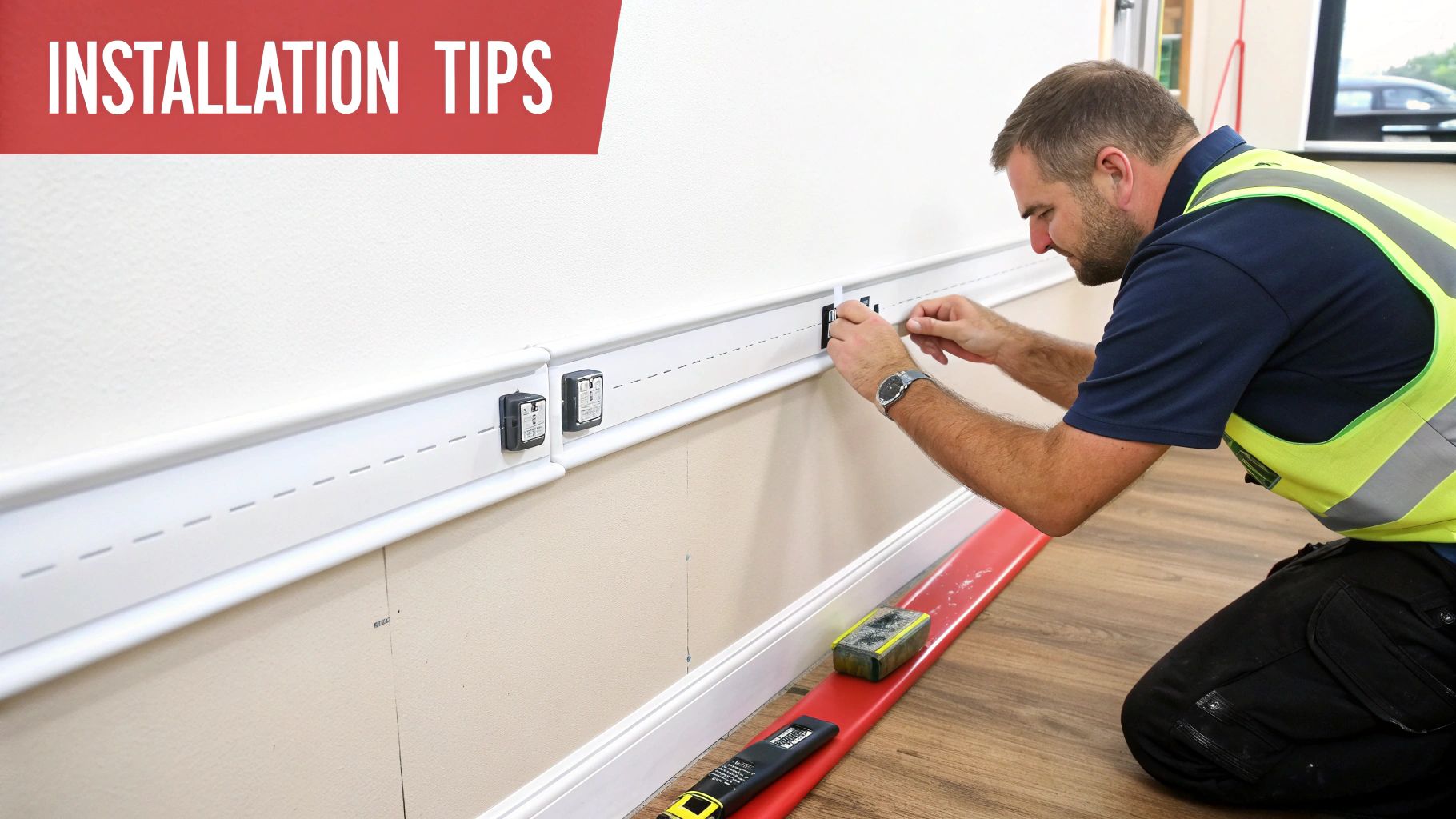
It begins with secure mounting. The trunking must be fixed firmly to the substrate using appropriate screws and plugs. A key differentiator of professional work is proper support spacing. Inadequate support, a common mistake, leads to sagging over time—a problem exacerbated by the high ambient temperatures across the GCC.
Key Installation Steps for a Professional Finish
Following a systematic process is crucial for a robust and compliant installation. Precision at every stage is paramount.
- Measure and Mark Accurately: Plan the entire route before cutting. Use a spirit level to ensure all horizontal and vertical runs are perfectly aligned. This attention to detail defines a professional finish.
- Cut Cleanly: Use a fine-toothed hacksaw or a dedicated PVC cutter to achieve clean, square cuts. Rough or angled cuts result in poor-fitting joints, compromising the integrity of the raceway.
- Deburr All Edges: After each cut, remove any sharp plastic burrs from the internal and external edges. This crucial step prevents damage to cable insulation during pulling.
- Secure with Proper Spacing: For horizontal runs, supports should be placed at intervals not exceeding 1 meter. For vertical runs, this can be extended to 1.5 meters. For heavy cable loads, reduce these distances to provide additional support.
Common Installation Mistakes to Avoid in the UAE Climate
Certain installation errors are more frequent and have more severe consequences in our region's environment. Avoiding these is key to a durable installation.
- Ignoring Thermal Expansion: This is a critical oversight in the GCC. Long, straight runs of PVC exposed to direct sunlight will expand and contract significantly. Failing to leave a small expansion gap (3-5mm) at joints or use expansion couplers will lead to buckling and warping.
- Over-Tightening Fixings: While secure fixing is important, over-tightening screws can crack or distort the PVC base. This weakens the fixing point and can make it difficult to attach the lid securely.
- Exceeding the 45% Fill Ratio: This rule is often violated on site. Overfilling trunking is a serious fire hazard, as it traps heat and prevents dissipation—a risk amplified by our high summer temperatures.
- Improper Use of Fittings: Using incorrect bends, tees, or couplers results in a sloppy, unprofessional finish. Always use manufacturer-approved fittings to ensure a seamless and secure system.
A professional installation is defined by the details. Taking the extra time to deburr cuts and account for thermal expansion separates a standard job from an excellent one that can withstand the unique challenges of the Dubai climate.
Navigating Regional Standards and Compliance
Operating within the highly regulated electrical industry in the UAE and GCC, compliance is non-negotiable. Your choice of PVC trunking size must align with international standards and specific local regulations. Adherence from the project's inception ensures safety, prevents delays, and avoids costly rework. Sourcing materials from a trusted supplier like GoSwitchgear, which provides certified electrical components UAE professionals can depend on, is a critical first step.
The key international standard is IEC 61084, which specifies the requirements for cable trunking and ducting systems, covering mechanical strength, material properties, and fire retardancy.
Meeting Local Authority Requirements
While global standards provide a baseline, compliance with local utility regulations is mandatory. Authorities such as the Dubai Electricity and Water Authority (DEWA) and Abu Dhabi Distribution Company (ADDC) have their own detailed guidelines that dictate product specifications and installation methods.
These local requirements often include:
- Material Quality: Mandates for high-grade, self-extinguishing PVC to prevent fire propagation.
- Fire Retardancy: Trunking must meet specific flame propagation test criteria to ensure building and occupant safety.
- Installation Practices: Strict enforcement of rules on support spacing, cable fill ratios, and mechanical protection, which are vital in the region's demanding environments.
The growth of the MEA PVC market is significantly driven by the correct specification of PVC trunking sizes. In the UAE, high-volume orders for sizes like 40x60mm and 100x150mm are common from electrical traders. A growing trend towards 50x75mm trunking is also evident, particularly in renewable energy projects. For panel builders and solar contractors, selecting the right size is crucial for accommodating high cable densities while leveraging PVC's ~40% weight reduction over steel and meeting all regulatory standards. For further insight, you can review research on the MEA Polyvinyl Chloride (PVC) sector.
Adherence to local utility standards is the foundation of a successful and legally compliant electrical project in Dubai or Abu Dhabi. Always verify that your selected PVC trunking size and material specifications meet these requirements to ensure project approval and long-term operational safety.
Frequently Asked Questions
From our experience supporting engineers and electricians across the UAE, certain questions about PVC trunking sizing arise frequently. Here are concise, practical answers.
What Is the 45 Percent Rule for Trunking Fill Capacity?
The 45% rule is a fundamental industry guideline stating that the cross-sectional area of your cables should not exceed 45% of the trunking's internal cross-sectional area.
This rule is not arbitrary; the remaining space is essential for air circulation, which allows heat generated by the cables to dissipate. In the high ambient temperatures of the UAE, this is a critical safety measure to prevent the degradation of cable insulation. It also provides practical capacity for future cable additions without requiring a complete re-installation.
Should I Use Standard or Slotted Trunking for a Control Panel?
For control panel applications, slotted PVC trunking is the industry-standard choice. Its design, featuring "fingers" and slots, is specifically engineered for panel wiring. It allows individual wires to be neatly routed to components like terminals, relays, and circuit breakers on a DIN rail, resulting in a clean, organized panel that is easy to troubleshoot and maintain.
Standard, solid-wall trunking is better suited for general-purpose cable routing along walls or in ceilings, where cables enter and exit at defined points rather than requiring frequent breakouts as seen inside a control panel.
What Are the Considerations for Outdoor Trunking in the UAE?
Outdoor electrical installations in the UAE must withstand extreme environmental conditions. For PVC trunking, three considerations are critical:
First, the trunking must be UV-stabilized. Without UV protection, intense sunlight will cause the PVC to become brittle, leading to cracking and premature failure. Second, it requires an appropriate IP (Ingress Protection) rating to protect cables from dust and moisture ingress. Finally, you must account for thermal expansion. For long, straight runs, install expansion couplers or leave small gaps at the joints to prevent the trunking from buckling and warping in the extreme heat.
Whether your project is in Dubai, Abu Dhabi, or elsewhere in the GCC, access to the right components is key. Explore a full range of certified electrical gear, from standard profiles to specialized solutions, at GoSwitchgear. Contact our team for project support and let us help you find the perfect PVC trunking size for your next installation. https://goswitchgear.com
Share this post

Related
Posts

A Guide to Choosing AC to DC Converters for UAE & GCC Electrical Systems
Master AC to DC converters with this comprehensive guide for engineers in the UAE & GCC. Learn selection, installation, and...

A Guide to Drill Machine Prices in the UAE for Technical Professionals
Find the best drill machine price in UAE. Our 2026 guide helps contractors and engineers choose the right corded, cordless,...

A Professional’s Guide to Choosing AGM VRLA Batteries in the UAE Climate
Discover why AGM VRLA batteries are the superior power solution for UPS, solar, and industrial systems in the UAE. Get...

How to Choose the Right Lithium Ion Battery Charger for UAE & GCC Projects
Discover how to select the right lithium ion battery charger for UAE projects. This guide covers specs, BMS integration, and...
.jpg)