
.jpg)

Posted by:
Category:
Comments:
Post Date:
Choosing the Right Network LAN Cable for UAE & GCC Projects
For engineers, panel builders, and procurement teams across the UAE and GCC, selecting the right network LAN cable is a critical decision that underpins the reliability of any modern infrastructure. In a region defined by rapid technological advancement and harsh environmental conditions, the choice is about building a digital backbone that delivers performance and withstands extreme heat, humidity, and dust. A failure here can lead to costly downtime and project delays.
The Foundation of Your Network in the GCC Climate
Specifying the wrong cable can introduce frustrating downtime, inexplicable system failures, and budget overruns. In demanding commercial environments like Dubai, Abu Dhabi, or Neom, where operational excellence is the standard, a substandard network LAN cable is simply not an option.
This guide provides a solution-focused roadmap for engineers and electricians to specify, select, and deploy network cabling that guarantees lasting performance and reliability for projects in the UAE and wider GCC.
By the end, you will be able to:
- Pinpoint the correct cable category for any application.
- Determine when shielding is necessary for industrial environments.
- Select jacket materials engineered for the local climate.
- Apply best practices for installation to ensure day-one performance.
From Cat5e to Cat7: Matching Cable Category to Application
Choosing the right network LAN cable category is like selecting the proper gauge of wire for an electrical circuit; it must match the load. For engineers and procurement teams in the UAE and Saudi Arabia, this decision is fundamental to building a network that is both high-performing and cost-effective. Each category represents a step-up in performance, designed to handle greater bandwidth and speed.
The demand for high-performance cabling is surging across the MENA region, driven by smart city initiatives and data center construction. Internet users in the region jumped from 130 million in 2016 to over 180 million by 2021, while fixed broadband connections swelled from 17 million to 29 million. This growth makes cables like Cat6 and Cat6A essential for any network built to last.
Cat5e: The Legacy Standard
Cat5e (Category 5 enhanced) has long been the baseline for Ethernet, offering speeds up to 1 Gigabit per second (Gbps) and a bandwidth of 100 MHz. While adequate for legacy IP telephony or basic residential networks, it lacks the capacity for modern commercial demands. For any new project in the UAE, Cat5e is no longer a viable option for future-proofing.
Cat6: The Commercial Workhorse
Cat6 (Category 6) provides a significant performance leap, supporting speeds up to 10 Gbps over shorter distances (up to 55 meters) and 1 Gbps up to 100 meters. With a bandwidth of 250 MHz, it strikes an optimal balance between performance and cost.
Cat6 has become the default standard for new commercial fit-outs, schools, and office buildings across the GCC. It capably handles VoIP, HD video streaming, and the data requirements of a modern business, making it a reliable energy management solution Dubai depends on.
The infographic below illustrates the performance progression across cable categories.
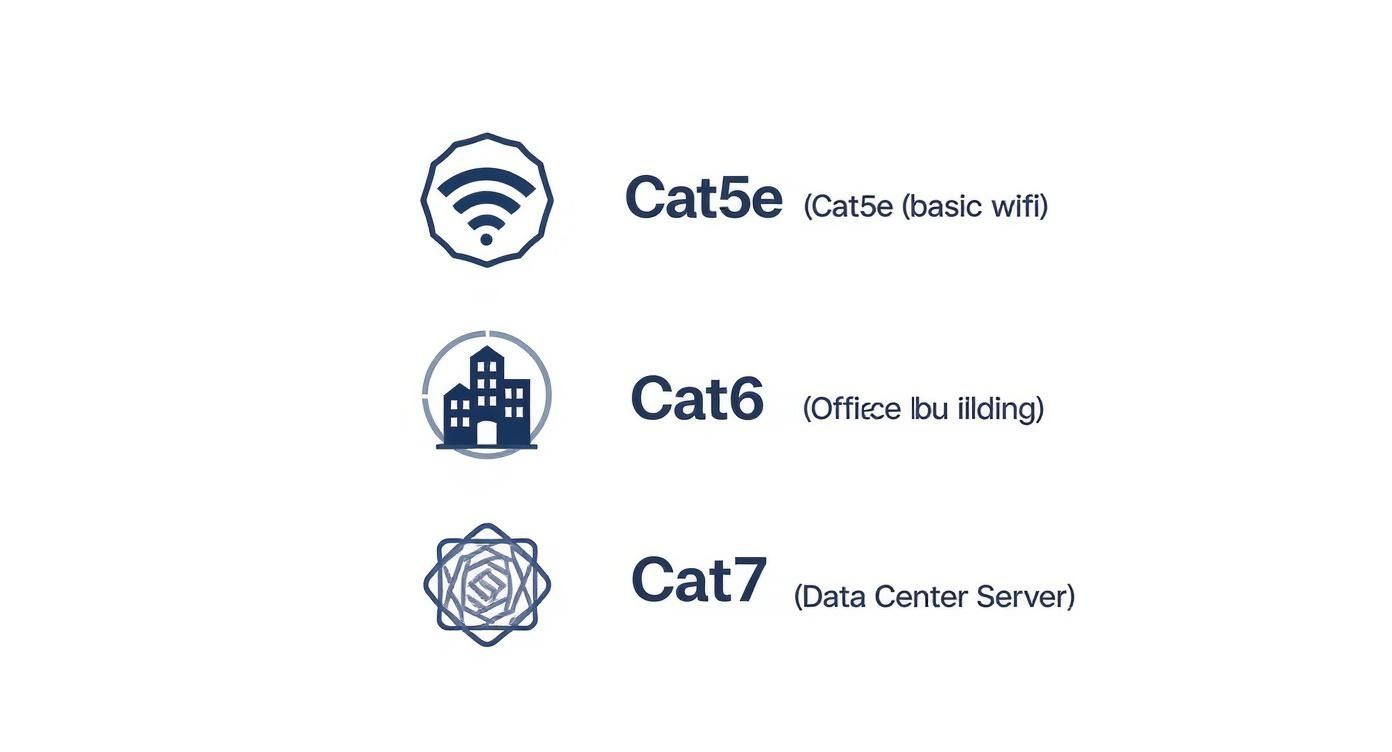
This visual shows the evolution from basic connectivity to the high-performance capabilities required in today's advanced networks.
Cat6A: The Future-Proof Solution
For networks that must support long-term growth, Cat6A (Category 6 Augmented) is the clear choice. It delivers a full 10 Gbps over the entire 100-meter channel and doubles the bandwidth to 500 MHz.
Its robust construction provides superior protection against crosstalk, making it essential for demanding applications:
- Data Centers: Where dense cabling requires maximum signal integrity.
- Power over Ethernet (PoE++): It reliably powers high-consumption devices like 4K security cameras and advanced wireless access points.
- Hospitals and Universities: Facilities with high user density and bandwidth-intensive equipment.
Specifying Cat6A for major projects in the UAE is a strategic investment in network longevity.
Cat7: High-Performance for Specialized Use
Cat7 (Category 7) pushes performance further with a bandwidth of 600 MHz and speeds exceeding 10 Gbps. It is always shielded (S/FTP), which virtually eliminates crosstalk.
However, Cat7 requires proprietary connectors like GigaGate45 (GG45) or TERA, not the standard RJ45, which can create significant compatibility challenges. For most GCC projects requiring 10 Gbps performance, Cat6A offers a more practical solution without the connector complexities. For a deeper technical comparison, this article on Cat6 vs Cat7 Ethernet cable provides valuable insights.
Key Takeaway for Engineers: The choice is about balancing current needs with future demand. Cat6 is the reliable standard for today’s commercial applications, but Cat6A provides the necessary headroom for the data-intensive smart buildings of tomorrow.
LAN Cable Category Performance Comparison Table
| Category | Max Speed | Max Bandwidth | Ideal Application in GCC |
|---|---|---|---|
| Cat5e | 1 Gbps | 100 MHz | Legacy systems, basic IP telephony. Not recommended for new builds. |
| Cat6 | 1 Gbps (10Gbps <55m) | 250 MHz | Standard commercial offices, schools, retail fit-outs in Dubai. |
| Cat6A | 10 Gbps | 500 MHz | Data centers, hospitals, high-power PoE, and smart building projects. |
| Cat7 | >10 Gbps | 600 MHz | Specialized AV or industrial environments with extreme EMI. |
Understanding these technical specifications allows you to specify a network LAN cable that supports your client's long-term operational goals.
UTP vs. STP: Shielding Against Electrical Interference
In the industrial and commercial environments common across the UAE and KSA, the physical construction of a network LAN cable is as crucial as its category rating. Signal integrity is paramount, especially when data cables are routed near power lines, HVAC systems, or variable frequency drives. The decision between Unshielded Twisted Pair (UTP) and Shielded Twisted Pair (STP) is therefore critical for engineers and panel builders.
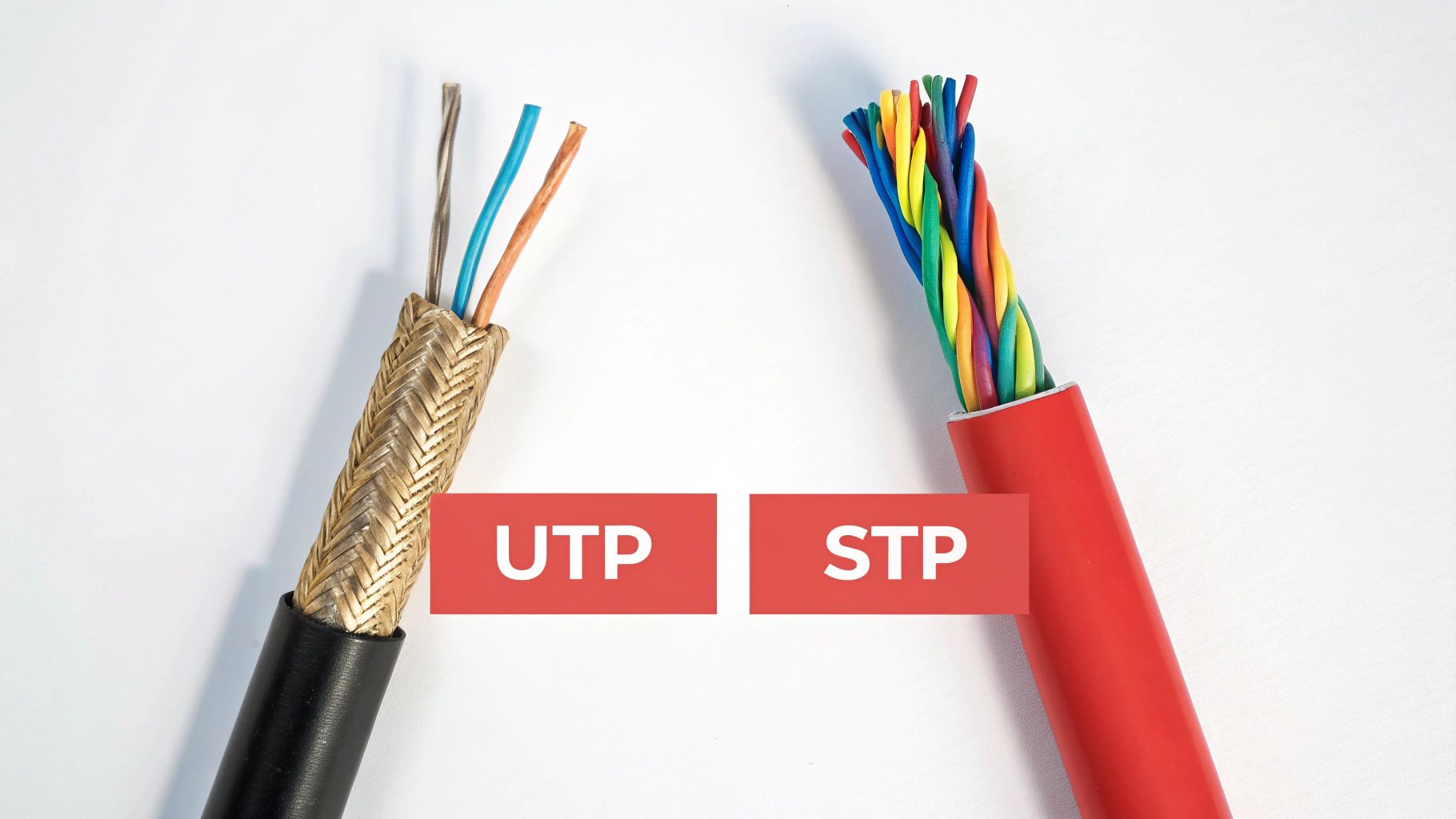
Electromagnetic interference (EMI), or "noise," from nearby electrical equipment can corrupt data signals, leading to packet loss, slow speeds, and network downtime. The cable's construction is the first line of defense.
Understanding Unshielded Twisted Pair (UTP) Cables
Unshielded Twisted Pair (UTP) is the most common type of network cable. It relies on the precise twisting of its internal copper wire pairs to cancel out external noise. This design is effective for standard office environments with low EMI.
UTP cables are widely used because they are:
- Cost-effective: Their simpler construction is ideal for large-scale deployments in controlled environments like a commercial office fit-out in Dubai.
- Flexible and Easy to Install: The absence of shielding makes UTP cables thinner and more pliable, simplifying installation in conduits and cable trays.
- Sufficient for General Use: A quality Cat6 UTP cable is typically adequate for connecting workstations and VoIP phones.
However, its reliance on twisting alone is a weakness. UTP cables are unsuitable for installation near high-voltage power lines or industrial machinery.
The Role of Shielded Twisted Pair (STP) Cables
When EMI is a known factor, Shielded Twisted Pair (STP) cables are essential. These cables include a conductive layer—typically a foil wrap or metal braid—beneath the outer jacket. This shield intercepts EMI and safely directs it to the ground.
STP is mandatory for applications such as:
- Industrial control panels in Jebel Ali Free Zone or KIZAD.
- Hospitals in Abu Dhabi with sensitive medical imaging equipment.
- Data centers where cables are bundled in high-density configurations.
Expert Insight for Electricians: The effectiveness of an STP cable depends entirely on proper grounding. An improperly terminated shield can act as an antenna, amplifying noise and performing worse than a UTP cable. Ensure a continuous ground path from the cable's shield, through the connector, to the grounded patch panel.
For a deeper understanding of shielding principles, our guide on EMI shielding for critical power systems provides relevant technical context.
Conductor Material: The Core of Performance
The conductor material within a network LAN cable significantly impacts performance, safety, and long-term reliability. The choice is between pure solid copper and Copper Clad Aluminum (CCA).
Pure Solid Copper Conductors
This is the industry standard specified by TIA/EIA-568. Copper’s superior conductivity and lower electrical resistance deliver:
- Superior Signal Strength: Less signal degradation (attenuation) over long distances.
- Safer PoE Performance: Lower resistance minimizes heat buildup in Power over Ethernet (PoE) applications, a critical safety factor.
- Enhanced Durability: Solid copper is more resilient to stress during pulling and termination.
Copper Clad Aluminum (CCA) Conductors
CCA cables, which use an aluminum core with a thin copper coating, are cheaper but present significant risks. CCA's higher resistance leads to greater signal loss, increased heat generation in PoE installations, and a high likelihood of failing TIA/ISO certification tests. For any professional project in the GCC, specifying 100% solid bare copper conductors is mandatory for ensuring reliability, safety, and compliance.
Meeting UAE Environmental and Regulatory Standards
Selecting a high-performance network LAN cable is only half the battle in the GCC. For an installation to endure, whether in a Dubai high-rise or a Saudi industrial facility, the cable must be engineered for the region's punishing environment. Failure to account for extreme heat, dust, humidity, and UV exposure can lead to premature failures, safety hazards, and non-compliance during project inspections.
Understanding jacket ratings and local regulations is a critical risk management strategy for any engineer or procurement team operating in the region.
LSZH for Public Safety and Air Quality
In high-occupancy public spaces like metro stations, airports, malls, and hospitals, fire safety is non-negotiable. Civil defense authorities across the UAE mandate LSZH (Low Smoke Zero Halogen) cables for these environments to protect human life.
Unlike traditional PVC jackets, LSZH materials are engineered to:
- Emit minimal smoke during a fire, preserving visibility for evacuation.
- Release no toxic halogen gases (e.g., chlorine), which cause respiratory injury and corrode sensitive electronics.
Specifying LSZH-rated network LAN cable is essential for compliance with local building codes and ensuring public safety.
UV Resistance for Outdoor and Solar Applications
The relentless GCC sun degrades standard cable jackets, causing them to become brittle and crack. This compromises the internal conductors, leading to inevitable network failure. For any outdoor cable run, a UV-resistant jacket is essential.
This is critical for:
- Rooftop security cameras exposed to direct sunlight.
- Solar energy projects where data cables link panels and inverters.
- External network links between buildings on industrial or campus sites.
A UV-resistant sheath ensures long-term cable integrity, preventing costly replacements and maintaining system uptime.
IP Ratings and Glands for Dust and Humidity Protection
The UAE's climate is characterized by fine dust and high humidity—both enemies of clean data connections. To protect termination points like connectors and junction boxes, it is crucial to use components with an appropriate Ingress Protection (IP) rating. An IP67-rated connector, for instance, offers complete dust protection and resistance to temporary water immersion.
This protection is achieved using high-quality cable glands that create a tight seal at the point of entry into an enclosure. For detailed specifications, refer to our comprehensive electrical cable gland chart. A properly sealed connection prevents corrosion and signal degradation caused by environmental factors.
The regional cable market was valued at USD 5.41 billion in 2024 and is projected to reach USD 9.85 billion by 2033, according to industry analysis. This growth is fueled by smart city projects and data center expansions across the GCC, all demanding specialized, durable electrical components UAE requires.
Matching cable specifications to local environmental and regulatory requirements is fundamental. It ensures your network performs reliably from day one and delivers a long service life, protecting your investment against the realities of the GCC climate.
Installation and Termination: Best Practices for Technicians
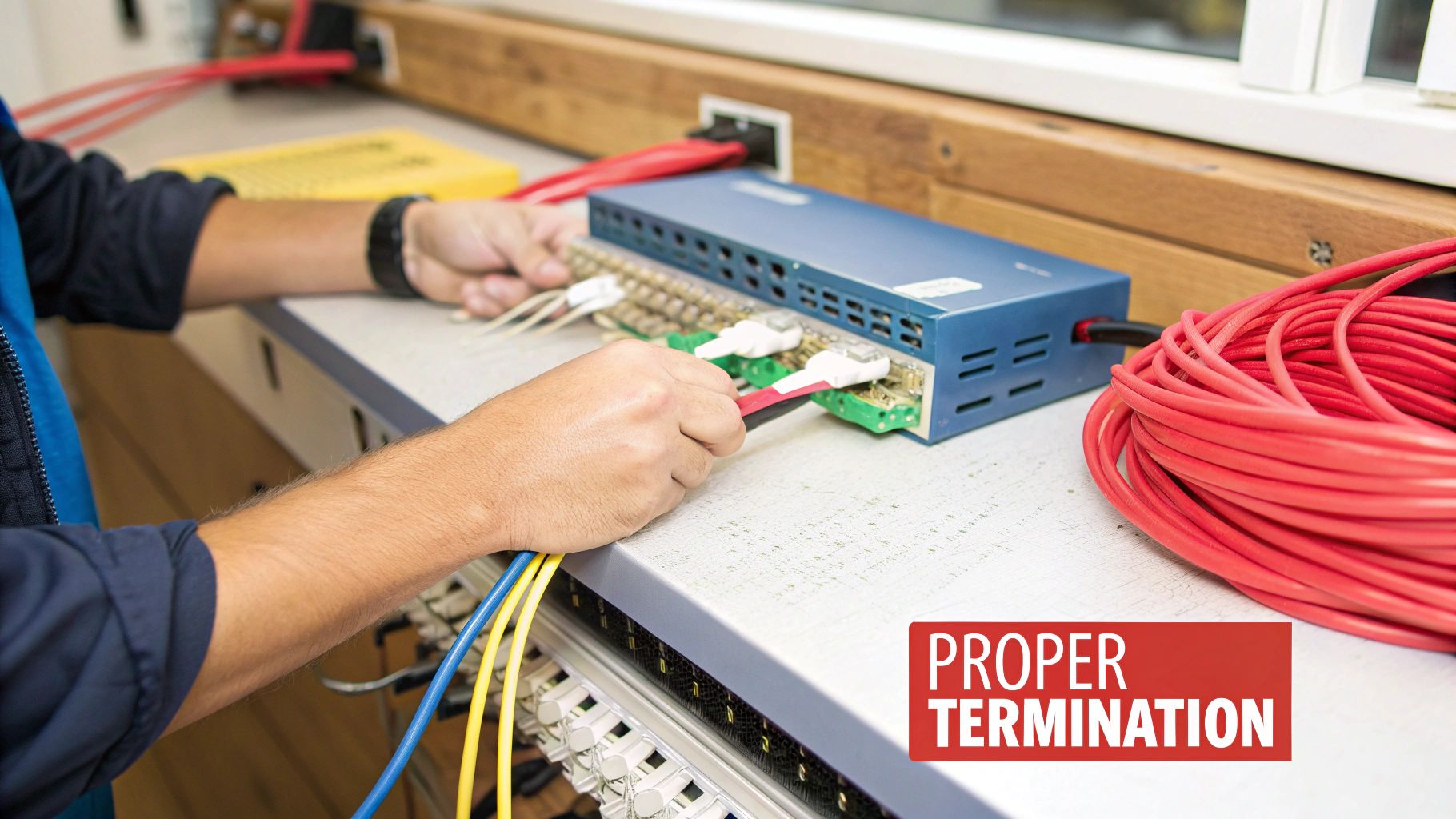
A premium network LAN cable will underperform if installed improperly. For electricians and technicians in the UAE, correct handling, installation, and termination are critical for the network's long-term health. A minor mistake during installation can lead to hours of complex troubleshooting later.
This section provides a field guide for ensuring every cable run contributes to a robust and reliable network, crucial for any project in Dubai, Abu Dhabi, or across the GCC.
Respecting the Physical Limits of the Cable
Every network LAN cable has a specified minimum bend radius—the tightest corner it can be routed around without damaging its internal structure. Exceeding this limit is a common installation error that can permanently degrade cable performance.
As a rule of thumb, the minimum bend radius for a standard UTP cable is four times the cable's outer diameter. For stiffer, shielded (STP) cables, this increases to eight times the outer diameter. Always consult the manufacturer’s datasheet for precise figures.
- Avoid sharp 90-degree bends: Route cables using gentle, sweeping curves.
- Do not overtighten cable ties: Using excessive force with zip ties can crush the cable jacket and deform the twisted pairs, causing performance issues. Use hook-and-loop ties for a safer alternative.
- Adhere to pulling tension limits: A network LAN cable should not be subjected to more than 25 pounds (110 Newtons) of pulling force. Exceeding this can stretch the copper conductors, causing irreversible damage.
Maintaining Pair Twists During Termination
The tight twists of the wire pairs are the primary defense against crosstalk and EMI. This is most critical at the termination point, whether connecting an RJ45 plug or punching down wires onto a patch panel.
The TIA/EIA-568 standard specifies that no more than 0.5 inches (13 mm) of a wire pair should be untwisted before it is terminated.
Adhering to this rule is what distinguishes a professional, high-performance link from an unreliable one, particularly with high-speed Cat6 and Cat6A cables. Using quality components like a GoSwitchgear Cat5e LAN Socket ensures a reliable termination point.
Segregation from Power Sources
Maintaining separation between data and power cables is a fundamental principle of network installation. It prevents EMI from high-voltage electrical lines from inducing noise onto data signals, which can cause packet loss and network instability.
Follow these guidelines for cable routing:
- Maintain Distance: Keep data cables at least 20-30 cm away from parallel power cables.
- Use Separate Pathways: Whenever possible, run data and power cables in separate conduits or cable trays.
- Cross at a Right Angle: If data and power lines must cross, ensure they do so at a 90-degree angle to minimize the area of interference.
- Use Shielding in Noisy Environments: In industrial control panels or areas with high EMI, a properly grounded shielded (STP) cable is the most effective solution.
By following these installation practices, panel builders and technicians can deliver network infrastructure that is robust, reliable, and meets its specified performance.
Network Testing and Sourcing from a GCC Supplier
Even with flawless installation, a project is incomplete until the network's performance is verified. For engineers and project managers in the UAE, post-installation testing is a non-negotiable step that validates both the quality of the materials and the workmanship.
Pairing rigorous testing with a strategic procurement approach is essential. Sourcing your network LAN cable from a reliable, local GCC supplier ensures you receive certified products, on-time delivery, and the expert support needed to navigate regional compliance requirements.
Certifying Installations with Professional Testing
A basic continuity check is insufficient for professional networks. Certification involves using specialized network cable analyzers to test a completed link against the stringent performance standards of TIA/ISO. This provides documented proof that the link can support its rated speeds, such as 10 Gbps for a Cat6A installation.
The certification process measures critical performance metrics:
- Attenuation (Insertion Loss): Measures signal degradation over the length of the cable. Excessive attenuation can lead to data loss.
- Near-End Crosstalk (NEXT): Tests for signal bleed between wire pairs near the transmitter. Failures are often caused by improper termination where pairs are untwisted too far.
- Wire Map: A fundamental test that confirms correct pin-to-pin connectivity and identifies miswirings, shorts, or open circuits.
Regularly diagnosing your network is key to maintaining performance. These essential network diagnostic utilities can help identify and resolve issues.
Sourcing Quality LAN Cables in the UAE and GCC
Your supplier choice is as critical as your cable choice. An effective procurement strategy focuses on building a relationship with a vendor who understands the unique demands of the GCC market. A reliable energy meter GCC supplier, for example, would understand local utility regulations.
When evaluating a supplier like GoSwitchgear, consider these key factors:
- Local Stock Availability: A supplier with warehouses in Dubai or Abu Dhabi can significantly reduce lead times and keep projects on schedule.
- Verifiable Certifications: They must provide documentation confirming compliance with international (TIA, ISO) and regional standards (e.g., LSZH for civil defense).
- Technical Support: Access to local experts for technical advice and on-site troubleshooting is an invaluable resource for engineers and installers.
- Product Traceability: A reputable supplier will guarantee their network LAN cable is made from 100% solid bare copper, not inferior CCA materials.
The Middle East and Africa wires and cables market was valued at USD 14.2 billion in 2024, driven by massive investments in data centers and 5G infrastructure—all of which demand premium cabling solutions.
Partnering with a dedicated local supplier like GoSwitchgear ensures your procurement team secures a reliable link in your project's supply chain, providing quality and peace of mind for installations across the UAE.
Conclusion: Building Resilient and Compliant GCC Networks
Selecting the right network LAN cable is a strategic decision that balances application requirements, environmental conditions, and installation quality. It is a long-term investment in your network's performance and reliability.
By understanding the technical differences between cable categories, the critical role of shielding, and local compliance standards, you are building a digital foundation that supports business objectives for years to come. This approach ensures your network infrastructure is not just a cost, but a valuable asset.
To ensure your next project in Dubai, Abu Dhabi, or anywhere in the GCC is built on a foundation of quality, contact our Dubai team. We provide specialized technical support and a full range of certified network solutions engineered for the demanding standards of the region. Let our team help you specify the right components for lasting operational success.
Frequently Asked Questions
Here are answers to common questions from engineers and project managers across the UAE and GCC regarding network cabling.
What Is The Best Network Cable For A Dubai Office Fit-Out?
For nearly all new commercial office projects in Dubai, we recommend Cat6A. It provides future-proof 10 Gbps performance, which is essential for today's data-intensive applications and the growing power demands of modern PoE devices. Furthermore, the superior shielding in Cat6A effectively mitigates interference in dense office environments where data cables run alongside numerous electrical lines.
Do I Need Shielded Cable For My Industrial Control Panel?
Yes, absolutely. Using a shielded cable (STP or S/FTP) inside an industrial control panel is non-negotiable. The panel environment is electrically noisy due to interference from VFDs, motors, and high-voltage components. This EMI can corrupt data signals in an unshielded (UTP) cable, leading to communication errors and system faults. The shield provides essential protection to maintain signal integrity.
Is Using CCA Cable Acceptable To Save Costs?
While Copper Clad Aluminium (CCA) cables are cheaper, we strongly advise against their use in any professional application. The initial cost savings are quickly offset by long-term problems. CCA has higher electrical resistance than pure copper, leading to significant performance degradation over distance, increased heat in PoE applications (a safety risk), and failure to meet TIA standards. Always specify 100% solid bare copper conductor cables for reliability, safety, and compliance.
For certified, high-performance network solutions that meet the specific demands of your project in the UAE, explore the extensive range at GoSwitchgear.
Share this post

Related
Posts
A Guide to Choosing AC to DC Converters for UAE & GCC Electrical Systems
Master AC to DC converters with this comprehensive guide for engineers in the UAE & GCC. Learn selection, installation, and...

A Guide to Drill Machine Prices in the UAE for Technical Professionals
Find the best drill machine price in UAE. Our 2026 guide helps contractors and engineers choose the right corded, cordless,...

A Professional’s Guide to Choosing AGM VRLA Batteries in the UAE Climate
Discover why AGM VRLA batteries are the superior power solution for UPS, solar, and industrial systems in the UAE. Get...

How to Choose the Right Lithium Ion Battery Charger for UAE & GCC Projects
Discover how to select the right lithium ion battery charger for UAE projects. This guide covers specs, BMS integration, and...
.jpg)