


How to Choose the Right Fluke Clamp Tester for UAE & GCC Projects
If you're an electrical professional working in the UAE or anywhere in the GCC, a Fluke clamp tester is an indispensable part of your toolkit. In a region defined by rapid industrial growth and demanding climate conditions, this instrument is crucial for safely and accurately diagnosing live electrical currents without causing costly downtime. For engineers, panel builders, and electricians in Dubai and Abu Dhabi, reliability isn’t just a feature—it's a necessity for commissioning and maintaining critical systems.
Why a Fluke Clamp Tester Is Your Most Trusted Tool
Working as an electrician or engineer in the UAE and wider GCC presents unique environmental challenges. Extreme heat, pervasive dust, and high humidity are not just minor inconveniences; they are operational hazards that can compromise inferior tools. While a generic diagnostic device might fail under such stress, a Fluke clamp tester is engineered for resilience in precisely these conditions, making it a vital energy management solution Dubai professionals rely on.
For panel builders and switchgear integrators, precision is paramount. A single inaccurate current reading can lead to an unbalanced panel, risking equipment failure or even electrical fires. Fluke has built its reputation on delivering consistently accurate measurements. This level of confidence is essential when signing off on complex installations, from troubleshooting HVAC systems in high-rise towers to diagnosing industrial motors on a factory floor.
The Critical Need for Non-Contact Measurement
The defining feature of a clamp meter is its ability to measure current without making direct physical contact. The traditional method involved cutting a wire to insert a multimeter in series—a process that is slow, hazardous, and impractical on a busy worksite.
A clamp tester operates on the principle of electromagnetic induction. By clamping the jaws around a live conductor, it measures the magnetic field to determine the current. This non-invasive method is fundamentally safer, faster, and more efficient, establishing it as the industry standard for modern electrical work.
This safety-first approach is vital when working with high-energy switchgear or inside confined panels—common scenarios across the UAE's expanding infrastructure.
Built for the GCC Environment
Fluke understands that tools used in the Middle East must be exceptionally tough. Their clamp testers are equipped with features specifically suited for local professionals:
- Robust Construction: These tools are designed to withstand drops, impacts, and the rigors of an active job site. They are built to last.
- High IP Ratings: Many Fluke models feature high ingress protection (IP) ratings, providing essential shielding against dust in industrial zones and moisture in coastal areas like Dubai.
- Temperature Tolerance: Fluke testers are engineered to deliver precise readings even in the extreme ambient temperatures common across the GCC region, ensuring performance integrity.
Ultimately, choosing a Fluke clamp tester is a strategic investment in safety, accuracy, and operational efficiency. It's a tool designed not just to function but to excel in the specific conditions that define our industry in the UAE and GCC. Explore the range of electrical components UAE professionals trust at GoSwitchgear.
How Clamp Testers Safely Measure Live Circuits
The primary advantage of a Fluke clamp tester is its ability to measure live electrical current without shutting down the circuit. This process is grounded in a core principle of physics: electromagnetic induction. Understanding this is key to appreciating why this tool is indispensable for electricians and panel builders across the UAE and the wider GCC region.
When electricity flows through a conductor, it generates a magnetic field. The clamp meter’s jaws act as a highly sensitive sensor. When you clamp them around a live cable, they detect and measure the strength of this magnetic field. The meter’s internal processor then translates this reading into a precise amperage value displayed on the screen.
This innovative method eliminates the most hazardous aspect of traditional current measurement—physically cutting a wire to splice a multimeter into the circuit. This non-invasive technique significantly reduces the risk of arc flash and electrocution, a critical safety benefit in the high-energy environments common in Dubai's commercial towers or Saudi Arabia's industrial plants.
Differentiating Core Technologies
Not all clamp meters are created equal. The two primary internal technologies are the current transformer and the Hall Effect sensor. Knowing the difference is crucial for selecting the right tool for your specific application.
- Current Transformer (CT) Method: This is the standard for measuring alternating current (AC). The clamp's jaws contain a coil of wire that acts as the secondary winding of a transformer, with the conductor being measured serving as the primary. The AC current's magnetic field induces a smaller, proportional current in the clamp's coil, which the meter measures. It's a highly effective method for standard AC circuits.
- Hall Effect Sensor Method: To measure both AC and direct current (DC), a Fluke clamp tester will typically use a Hall Effect sensor. This semiconductor component detects the magnetic field and produces a voltage output directly proportional to the field's strength. This capability is essential for working on solar power systems, battery backups, and modern variable frequency drives (VFDs), all of which involve DC components.
This infographic effectively illustrates the core principles of safety, reliability, and precision that define a Fluke clamp tester.
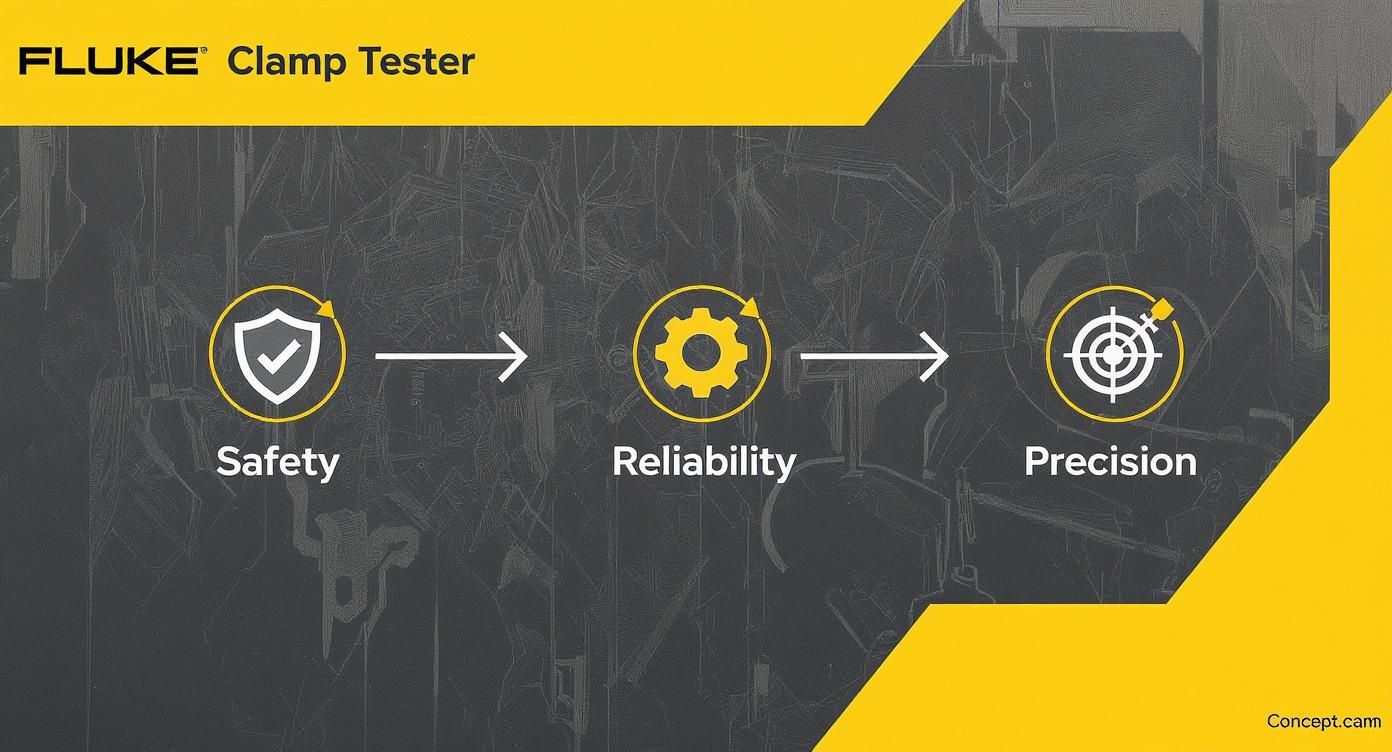
It showcases how combining non-contact measurement (safety), rugged design (reliability), and advanced sensors (precision) makes this tool a cornerstone of modern electrical work.
The Unmatched Safety Advantage
The practical safety benefits cannot be overstated. A traditional multimeter requires exposing live conductors, creating a direct path for dangerous electrical energy. A clamp meter, however, allows you to keep insulation intact and your hands safely away from live parts.
By measuring the magnetic field instead of the electricity itself, the Fluke clamp tester provides a critical layer of isolation between the technician and potentially lethal voltages. This principle is the foundation of modern electrical safety practices.
Knowing how to safely check live circuits is especially important for jobs like when installing an EV charger at home, where verifying the load and ensuring solid connections is mandatory.
The ability to quickly and safely check current at a distribution board without disrupting power is a game-changer. This non-invasive approach not only protects the professional but also prevents costly downtime for the facility, making it the superior method for any diagnostic or maintenance task in a live electrical environment.
Decoding The Features That Matter In The GCC
Choosing the right Fluke clamp tester for a job in the UAE or the wider GCC requires more than just checking the maximum amp rating. Our region's advanced electrical infrastructure and harsh environmental conditions demand a deeper look at the specifications. For any engineer, panel builder, or electrician, getting this choice right is critical for success.
A smart selection means understanding the details that distinguish a good tool from the perfect tool for your daily work. Whether it’s obtaining an accurate reading on a complex modern load or ensuring safety in a high-energy panel, the right features make all the difference.
True RMS: The Non-Negotiable Standard
In any modern facility in Dubai or Abu Dhabi, electrical loads are rarely simple sine waves. The widespread use of variable frequency drives (VFDs) in HVAC systems, along with LED lighting and computer power supplies, creates distorted, or "non-linear," electrical waveforms. This has significant implications for measurement accuracy.
A basic clamp meter without True RMS capability will produce inaccurate readings on these distorted signals, sometimes by as much as 40%. Such an error could lead to misdiagnosing a healthy motor or, worse, overlooking an overloaded circuit that poses a serious hazard.
A Fluke clamp tester with True RMS (Root Mean Square) capability is specifically designed to calculate the true effective value of these distorted waveforms. For professionals working on commercial or industrial systems in the GCC, this is an essential feature for reliable troubleshooting.
Understanding CAT Safety Ratings
When working inside a live switchgear panel, safety is the top priority. This is where CAT (Category) safety ratings are critical. These IEC-defined ratings indicate where a tool can be safely used within an electrical system, based on the risk of transient overvoltage events like lightning strikes or large load switching.
- CAT III: This rating is suitable for measurements on three-phase distribution systems, including commercial lighting, most switchgear, and large motors on the distribution side of a facility.
- CAT IV: This is the highest level of protection, mandatory for any work at the source of the installation, such as utility connections, main service entrances, and primary circuit protection.
For panel builders and industrial electricians in the UAE, a meter with a minimum rating of CAT III 600V is the baseline. However, for work on utility connections or the main incomer of a large building, a CAT IV 600V / CAT III 1000V rated tool is the only safe choice. Always match the CAT rating to your work environment—it is a non-negotiable part of your personal protective equipment (PPE).
Advanced Features for Sharper Diagnostics
Beyond the basics, certain advanced features in a Fluke clamp tester can significantly enhance your diagnostic capabilities, saving time and effort on site.
The inrush current function is one of the most useful. When a large motor starts, it draws an instantaneous spike of current. This feature captures that peak, helping you diagnose nuisance breaker trips or confirm proper motor start-up.
Another valuable feature is Fluke Connect®. This technology allows you to place a clamp meter in a hazardous or hard-to-reach location—such as inside a closed panel—and read measurements safely from a distance on your smartphone. It is incredibly useful for logging data in large facilities and reducing exposure to live circuits.
The Importance Of IP Ratings And Build Quality
Finally, do not overlook the physical durability of the tool, especially in the GCC. An IP (Ingress Protection) rating indicates how well the meter is sealed against dust and moisture. A rating like IP54 signifies strong protection against dust ingress and water splashes, making it a reliable choice for dusty industrial sites or humid coastal areas.
The demand for such specialized tools reflects regional market trends. The Fluke clamp meter market has grown significantly across the Middle East, driven by large-scale infrastructure projects. The region's electrical equipment market was valued at around USD 32 billion and continues to grow, underscoring the need for precision instruments. read the full research on the Middle East and Africa electrical equipment market to learn more. For all your testing equipment, GoSwitchgear is your trusted source for energy management solution Dubai and across the GCC.
To aid your selection, here is a comparison of popular Fluke models, highlighting features most relevant for work in our region.
Fluke Clamp Tester Feature Comparison for GCC Applications
| Feature | Fluke 376 FC | Fluke 378 FC | Fluke 325 | Importance in GCC Context |
|---|---|---|---|---|
| True RMS | Yes, AC/DC | Yes, AC/DC | Yes, AC/DC | Essential. Accurately measures non-linear loads from VFDs and modern electronics common in the GCC's advanced infrastructure. |
| CAT Safety Rating | CAT IV 600V, CAT III 1000V | CAT IV 600V, CAT III 1000V | CAT IV 300V, CAT III 600V | Critical. CAT IV rating is vital for safety when working on service entrances and utility connections. |
| Fluke Connect® | Yes | Yes | No | High. Enables remote readings for safety in high-energy panels and data logging for large facility management. |
| Inrush Current | Yes | Yes | No | Very High. Crucial for diagnosing motor start-up issues in HVAC and industrial applications, which are widespread. |
| iFlex® Probe | Included | Included | Not included | High. Provides flexibility for measuring current in tight spaces or on large, awkwardly shaped conductors in panels. |
| IP Rating | IP30 | IP30 | IP40 | Moderate to High. Higher IP ratings provide better protection against dust and moisture in construction and industrial sites. |
| FieldSense™ | No | Yes | No | High. Allows for simultaneous voltage and current measurement without test leads, increasing speed and safety on the job. |
This table breaks down how each model compares against the daily challenges faced by electricians and engineers in this region. Understanding these features will help you select the right tool for the job.
Putting the Clamp Meter to Work: Real-World Scenarios in the UAE
Theory is valuable, but a tool's true worth is proven on the job site. For electricians and engineers across the UAE, a Fluke clamp tester is the instrument that ensures tasks are completed faster, safer, and with uncompromising accuracy. Here are some real-world scenarios where these tools solve everyday problems.
These examples illustrate how a clamp meter saves time, prevents costly failures, and keeps operations running smoothly, from Dubai's high-rises to Jebel Ali's industrial zones.
Scenario 1: Balancing Loads in a Bustling Commercial Panel
Imagine commissioning a new retail outlet in a major Dubai mall. The main distribution board powers everything from lighting to kitchen equipment. An unbalanced load across the three phases can lead to overheating neutral wires, nuisance tripping, and premature equipment failure—risks no business can afford.
With a Fluke 376 FC clamp meter, you can assess the full picture without a shutdown. Simply clamp the jaw around each main phase conductor. If Phase A is pulling 150A, Phase B is at 120A, and Phase C is at 180A, you have instantly identified a significant imbalance. Armed with this data, the panel builder can redistribute circuits to balance the load, ensuring the system runs safely and reliably.
Scenario 2: Nailing Down an HVAC Motor Fault in an Abu Dhabi High-Rise
In the UAE's climate, air conditioning is a mission-critical system. When a large rooftop air handling unit intermittently trips its breaker, a failing motor is a likely cause. However, replacing it based on a hunch is a costly and disruptive undertaking. You need definitive proof.
This is where a Fluke clamp tester with an inrush current feature excels.
- First, clamp the meter around one of the motor's power leads.
- Next, activate the inrush function.
- Finally, have the motor started.
The meter captures the peak current drawn during start-up. If the reading significantly exceeds the motor's specifications, you have found the problem—a clear sign of excessive strain from worn bearings or another internal fault. This single measurement justifies the replacement and prevents a catastrophic failure during peak summer heat.
Scenario 3: Pinpointing a Control Circuit Glitch in a Jebel Ali Factory
Modern factories in the Jebel Ali Free Zone rely heavily on automation. Control panels with 24V DC circuits are the brains behind production lines. When a line halts due to an unknown fault and the PLC offers no clear error codes, every minute of downtime costs money. The issue is likely a single faulty sensor or actuator.
A clamp meter that can measure low DC current, such as the Fluke 325, is invaluable here. Instead of disconnecting and testing each component, you can clamp the meter around the small wires feeding each device. By checking the milliamp (mA) draw, you can instantly spot an anomaly—a component drawing too much current or none at all. This allows you to quickly isolate the fault in complex energy management solution Dubai systems, reducing troubleshooting time from hours to minutes.
The demand for rugged, precise tools is growing, fueled by massive infrastructure projects across the region. The global Fluke market, which includes clamp meters, is projected to climb from USD 6.71 billion to USD 10 billion by 2035. A significant portion of this growth is driven by the Middle East, supported by the UAE's renewable energy goals and Saudi Arabia's Vision 2030. this expanding market and its regional drivers.
Essential Safety And Maintenance Practices
Owning a powerful diagnostic tool like a Fluke clamp tester is only half the battle; using it safely is paramount. While its non-contact design enhances safety, complacency remains a significant risk for any electrical professional. Adhering to a strict protocol for safety checks and routine maintenance is crucial for protecting yourself and your colleagues on job sites across the UAE and GCC.
Before clamping onto a live conductor, your safety routine must be second nature. This is your pre-flight check before entering a live electrical environment.
Your Pre-Use Safety Checklist
A few seconds of inspection can prevent a disaster. Never assume your meter is ready for use.
- Visual Inspection: Quickly examine the meter for cracks or damage to the casing. Pay close attention to test leads and probes—any frayed insulation or exposed metal is a critical fault. If you find any damage, take the meter out of service immediately.
- Correct Function Selection: Always double-check that the rotary dial is set to the correct function before connecting to a circuit. Attempting to measure voltage with the dial set to ohms can damage the meter and create an arc flash hazard.
- Understand CAT Ratings: As previously discussed, ensure your meter’s CAT rating (e.g., CAT III 1000V or CAT IV 600V) is appropriate for the work environment. Using an underrated meter in a high-energy zone is extremely dangerous.
Following these practices, and understanding the fundamentals of how to prevent electrical fires, is non-negotiable when working with live circuits.
Best Practices For Accurate And Safe Measurement
Once your pre-use checks are complete, these steps will help you obtain accurate readings while minimizing risks.
- Clamp One Conductor at a Time: The meter measures the magnetic field around a single wire. Clamping multiple conductors will cause the opposing magnetic fields to cancel each other out, resulting in an inaccurate reading near zero.
- Center the Conductor in the Jaws: For optimal accuracy, position the wire in the center of the clamp jaws. This ensures the sensor detects the strongest, most consistent magnetic field.
- Wear Appropriate PPE: Your meter is just one part of your safety system. Always wear the correct personal protective equipment (PPE) for the job, including insulated gloves and safety glasses, based on the circuit's energy level.
Proper technique is not just about accuracy; it is a fundamental safety discipline. The way you handle your Fluke clamp tester reflects your commitment to a safe working environment.
Long-Term Maintenance for Reliability
Proactive care will ensure your Fluke clamp tester remains a reliable tool for years.
- Battery Care: Weak batteries can cause dangerously inaccurate readings. Monitor the low battery indicator and replace batteries promptly. If storing the meter for an extended period, remove the batteries to prevent leakage and corrosion.
- Keep it Clean and Dry: In the GCC's dusty and humid environment, regularly wipe down your meter with a dry, clean cloth. Over time, debris can compromise internal components.
- Annual Calibration: For professionals, annual calibration is essential. It is the only way to verify that your meter is measuring within its original factory specifications, ensuring the data you rely on is trustworthy and compliant with local standards.
Find Your Fluke Clamp Tester At GoSwitchgear
With a solid understanding of the technical specifications and real-world applications, the final step is selecting the right Fluke clamp tester for your needs. At GoSwitchgear, we simplify this process for professionals across Dubai, Abu Dhabi, and the entire GCC.
As your local partner, we provide practical solutions tailored to the unique demands of working in the region’s challenging environments, from industrial plants to complex commercial high-rises.
Your Go-To Supplier in the UAE
Whether you are a panel builder requiring a high-current clamp meter for precise load balancing or a maintenance engineer troubleshooting delicate control circuits, we have the right instrument. Our curated selection of Fluke products ensures you get a tool with the appropriate CAT safety ratings and essential features like True RMS and inrush current measurement.
This focus on quality reflects the region's growth. The digital clamp multimeter market in the Middle East & Africa is expanding rapidly, driven by industrialization in the UAE and Saudi Arabia. This market segment accounts for 8-12% of the broader MEA revenue, highlighting the high demand for reliable tools built for local standards. Discover more insights on the digital clamp multimeter market.
Matching the Tool to the Application
To simplify your decision, here are common scenarios and the ideal tool for each:
- Commercial HVAC & Industrial Motors: For diagnosing start-up issues, a model with inrush current and a high CAT rating is essential. The Fluke 376 FC is perfectly suited for this.
- General Electrical Contracting: A versatile workhorse that can handle diverse tasks is needed. The Fluke 325 offers an excellent balance of True RMS accuracy, durability, and core functions.
- Advanced Diagnostics & Safety: For maximum safety and efficiency, the Fluke 378 FC is unmatched. Its FieldSense™ technology allows for simultaneous voltage and current readings without test leads making contact with live parts.
Choosing the correct Fluke clamp tester is an investment in safety, accuracy, and efficiency. It ensures that every measurement you take is one you can trust, protecting both equipment and personnel.
Our team at GoSwitchgear is ready to assist. We encourage engineers and procurement teams in Dubai and Abu Dhabi to contact us for expert consultations, product demos, and quotes tailored to your project's specific needs. Explore our complete range of Fluke instruments and see the electrical components UAE professionals rely on daily.
Got Questions? We've Got Answers
If you're an engineer or technician working in the GCC, you likely have questions about Fluke clamp testers. Here are straightforward answers to some of the most common inquiries to help you make an informed decision.
What Is The Real Difference Between A Multimeter And A Clamp Tester?
The primary difference lies in how they measure current. A traditional multimeter requires you to physically cut a wire and place the meter in series with the circuit. This is disruptive, causes downtime, and increases safety risks.
A Fluke clamp tester, however, is non-invasive. You simply open the jaws and clamp them around a conductor to get a reading. It works by measuring the magnetic field generated by the current, so you never need to break the circuit. For professionals working on live electrical panels in the UAE, this non-contact method is significantly safer and more efficient.
Why Is True RMS So Important For Facilities In Dubai?
Modern buildings and industrial sites in Dubai are filled with equipment that produces non-linear loads, such as variable frequency drives (VFDs), LED lighting, and server rooms. These loads create distorted electrical waveforms.
A basic clamp meter cannot accurately measure these signals and can produce readings that are off by as much as 40%. A True RMS clamp tester is specifically designed to calculate the true heating value of these distorted signals, providing accurate data for load balancing and troubleshooting. For any serious professional in the region, True RMS is an essential feature.
How Often Should I Calibrate My Fluke Tester In The UAE?
For any application where accuracy is critical, the industry standard is annual calibration. This involves sending your meter to a certified lab to verify that it performs according to the manufacturer's original specifications.
Considering the UAE's environment—intense heat, humidity, and dust—adhering to an annual calibration schedule is a wise practice. It ensures your measurements are trustworthy, maintains your tool's condition, and ensures compliance with project and safety standards.
At GoSwitchgear, we don't just sell tools; we provide the expertise to help you get the job done right. Our team is here to help you select the perfect Fluke clamp tester for your specific needs. Reach out to our Dubai team for project support.
Explore our full range of Fluke testing and measurement instruments at GoSwitchgear




.jpg)
Leave a Reply