
.jpg)

Posted by:
Category:
Comments:
Post Date:
Why Does My Breaker Keep Tripping in Commercial Buildings: HVAC, Lighting & Equipment Loads
30 Second Summary
- When the breaker keeps tripping, it’s often due to excessive load from HVAC systems, lighting surges, or heavy equipment starting, which can overload the circuit.
- If the circuit breaker keeps tripping, it could be because the circuit is undersized for the equipment, causing frequent tripping.
- Damaged or outdated wiring can lead to short circuits or increased resistance, causing the breaker to keep tripping.
- Over time, a circuit breaker can deteriorate and malfunction, causing the breaker to keep tripping prematurely.
- When the breaker keeps tripping, it disrupts operations, affects equipment performance, and creates safety risks, necessitating regular inspection and maintenance.
1. What Happens When a Breaker Trips?
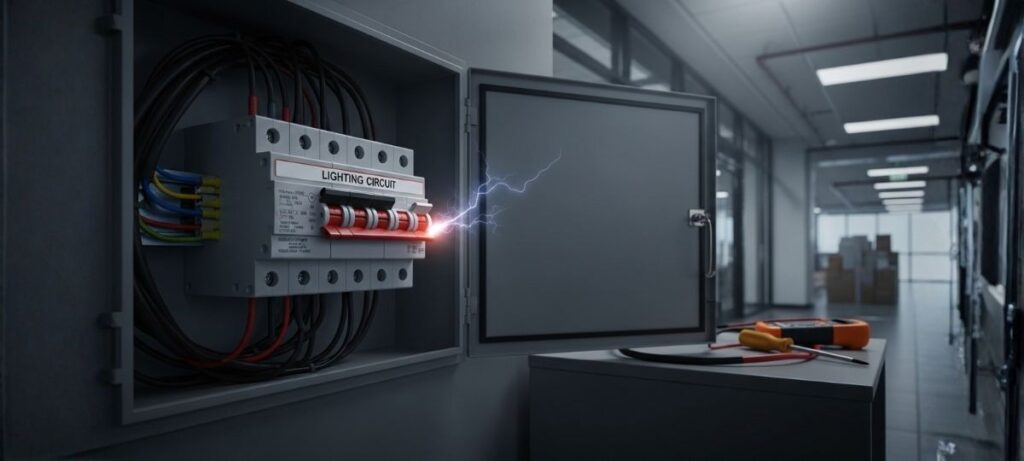
When the circuit breaker trips, it interrupts the flow of current, turning off power to a circuit. You might see the handle in the middle or “off” position. A tripped breaker means something triggered an abnormal condition.
When the breaker keeps tripping, it isn’t just bad luck; it's a warning.
A trip breaker event may arise from what causes a breaker to trip, such as overload or a fault.
Understanding why do circuit breakers trip is key to resolving it rather than simply resetting and forgetting.
2. The Big 3: HVAC, Lighting & Equipment Loads
In commercial buildings, three heavy load categories dominate:
- HVAC systems – chillers, rooftop units, compressors
- Lighting loads – large banks of fixtures, ballasts, surge loads
- Equipment loads – motors, conveyors, data-centers, process machinery
Because these draw large currents, they often stress circuits. If you ask why does my circuit breaker keep tripping, it often traces to one or more of these. In fact, one study names overloaded circuits and frequent breaker trips as top issues in commercial spaces. Also, load calculation errors are common.
3. Why The HVAC Circuit Breaker Trips
Your HVAC system may be the main culprit when your breaker keeps tripping. Here’s why:
3.1 High Starting (Inrush) Currents
When compressors or large motors start, they draw inrush current far above their running current. If the breaker is undersized or the circuit isn’t designed to handle that surge, it will trip immediately.
As one source notes: “When equipment is malfunctioning … may draw excessive current.”
3.2 Malfunctioning Motors or Compressors
A failing motor winding, excessive refrigerant charge, which refers to the amount of refrigerant (a chemical fluid) that is present in an HVAC or refrigeration system, or blocked airflow, any of these can make the compressor draw more than normal, exceeding the breaker’s capacity. This leads to the classic question: “Why would a breaker trip when nothing seems wrong?”
3.3 Overload from Continuous Operation
HVAC units often run continuously or for long stretches. According to the code, continuous loads must be considered at 125 % of the rated current when sizing breakers. If that isn’t accounted for, you’ll see repeated trips.
4. Why Lighting Circuits Trip in Commercial Buildings
Lighting loads in commercial settings might seem benign, just bulbs and fixtures, but the reality is different.
4.1 Ballast and Flicker Loads
Commercial lighting often uses ballasts or LED drivers, which introduce harmonic currents or surge during switching. These abnormal currents can cause the breaker to trip. One resource shows that lighting panels experience current swells and voltage sags from such loads.
4.2 Overloading from Add-ons
Suppose a facility adds new lighting banks, plug-in loads, and office expansions. Without recalculating the circuit, you may push a branch circuit past its limit, so the circuit breaker keeps tripping.
As noted by Southam Electrical: “Too many devices on a circuit… causing frequent tripped breakers.”
4.3 Mismatch Between Breaker and Wiring
If the breaker is oversized incorrectly relative to the conductor, the breaker might trip prematurely or fail to protect, circuit protection accessories are a must. That crosses into the realm of what causes a breaker to keep tripping, improper infrastructure.
Proper load calculation is vital.
5. Why Equipment Loads Cause Trips
When heavy-duty equipment is in play, the circuits and breakers are under heavier pressure.
5.1 Motors, Conveyors, Heavy Machinery
Industrial motors, compressors, machines, data center UPS loads, can draw large current spikes and high running currents. If the branch circuit isn’t robust, a breaker keeps tripping scenario arises.
From the commercial-industrial guide: “Commercial and industrial buildings … heavy-consumption devices … the breaker may trip” due to overload.
5.2 Multi-device Circuits
Sometimes multiple heavy loads are tied into one circuit. If one additional load is added, the circuit breaker keeps flipping unexpectedly.
You must distribute loads logically and assess demand factors accordingly (as per NEC). 5.3 Faulty or Aging Equipment
Equipment that is failing may draw more current, create ground faults, or have insulation breakdown, all of which can create a tripped breaker even with ‘normal’ loading.
Aged equipment + aged breaker = unreliable protection.
Summary: For equipment-driven trips, check the connected loads, start/inrush profiles, maintenance of machinery, and ensure proper circuit division.
6. Other Common Causes: Short Circuits, Ground Faults & Aging Breakers
Not all trips are from overloads. Some are more subtle but equally critical to understand, especially when you ask why circuit breakers trip or what causes a breaker to trip.
6.1 Short Circuits
A hot wire touching a neutral or ground creates a low-impedance path and huge surge current. The breaker should trip almost instantly. In older installations, damaged insulation or pinched wires are common culprits.
6.2 Ground Faults & Arc Faults
Ground faults (hot to ground) or arc faults (spark/flash across a gap) can trip breakers in either standard or sensitive protective devices. These are fire-hazard conditions.
6.3 Nuisance Tripping & Aging Devices
Sometimes breakers trip when no obvious fault exists. This may be nuisance tripping caused by inrush currents, the initial surge of electricity drawn when an electrical device starts, which can be much higher than the device’s running current. It may also be caused by poor coordination or degradation of the breaker’s mechanism. An aged breaker may no longer tolerate the designed current or may trip too easily.
7. Is It Dangerous If the Circuit Breaker Keeps Tripping?
Absolutely. If your breaker keeps tripping, you cannot treat it as just an annoyance. Some reasons why it’s dangerous:
- Repeated trips indicate underlying faults that may escalate to wiring overheating or fire.
- A breaker that fails to trip when it should (because it’s worn or the wrong size) is a fire and safety hazard.
- Down time from unexpected trips affects business operations, mission-critical loads, and equipment reliability.
8. How to Fix a Breaker That Keeps Tripping
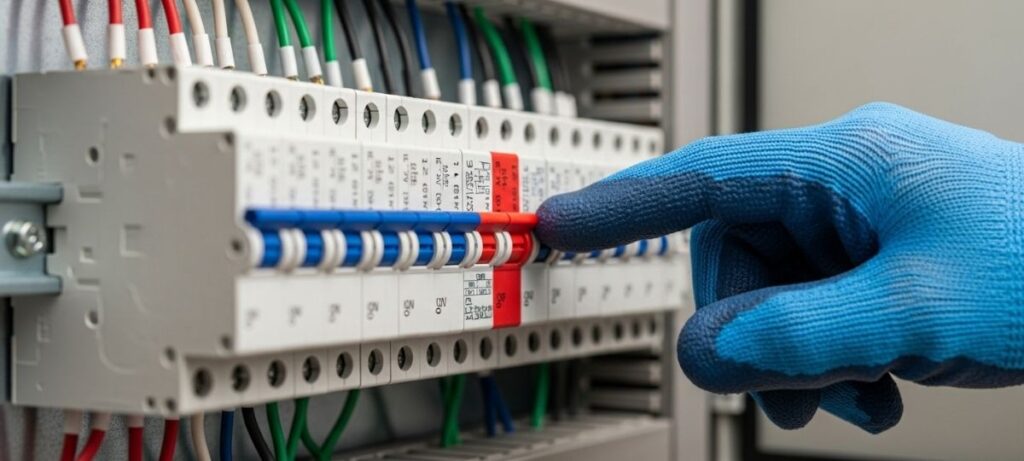
Let’s get practical. If you’re wondering how to fix a breaker that keeps tripping, here are the steps you can follow.
Step 1: Identify the Circuit and Load
Find exactly which circuit is tripping. What is attached? HVAC zone, lighting bank, equipment group? As referenced: “Identify the affected circuit … look for the breaker in OFF or TRIPPED”
Switch off connected devices first, then reset the breaker.
Step 2: Check Load vs Breaker Rating
Use a [circuit breaker size calculator] or consult a licensed electrician to verify the breaker rating matches the conductor size and load.
Are you exceeding breaker capacity? Are you adding new loads?
Step 3: Inspect Wiring & Connections
Look for discolored wires, loose terminations, panel overheating, corrosion, and insulation breakdown. These may not show until a load is applied.
Step 4: Inspect the Breaker Itself
If a breaker is old, shows burn marks, or doesn’t stay firmly in ON or OFF, it may be faulty. One case study found that a $42 breaker’s failure caused major business disruption. Consider replacing the breaker rather than always resetting it.
Step 5: Check Equipment & Motor Loads
For HVAC or heavy machinery: check motor start current, compressor condition, refrigerant level, bearings, airflow—anything that increases current draw.
Step 6: Distribute and Balance Loads
If too many loads are tied together, you may exceed demand factors. Use proper load calculation tables (NEC Article 220) and ensure circuits are balanced. Consider adding sub-panels or additional branch circuits.
Step 7: Preventive Maintenance
Create a schedule, inspect panels annually, monitor thermal signatures, and ensure loads are within expected values. Over time, small fixes avoid big outages.
Conclusion
If your breaker keeps tripping and you can’t identify the cause, schedule a full electrical audit with a qualified commercial electrician. Use this as an opportunity to assess your circuit breakers, review the sizing using a circuit breaker size calculator, explore types of circuit breakers that might suit your loads, and shop at Goswitchgear electrical parts store for any replacements or upgrades.
FAQs
Q1: Why does my breaker keep tripping when I turn on the HVAC?
When you switch the HVAC on, the motor draws its inrush current. If the circuit or breaker isn’t sized to handle that surge, the breaker will trip.
You may also have a compressor fault, increasing current draw.
Q2: Is it dangerous if the circuit breaker keeps tripping?
Yes. Frequent tripping reveals hidden faults. A breaker that fails to trip due to wear or mis-sizing is even more dangerous.
Q3: What causes a breaker to keep tripping even with minimal load?
Possible causes: aging breaker, loose wiring/terminals, ground fault or arc fault, or improper coordination. Investigate wiring, connections, and breaker condition.
Q4: My breaker trips immediately when I plug something in. Why?
That sounds like a short circuit or heavy inrush device. A circuit fault may exist or the device may exceed the breaker’s capacity at startup.Q5: How often should commercial breakers be inspected?
At least annually, or whenever major load changes occur. Under heavy use, more frequent inspection is advisable.
Share this post

Related
Posts

Selecting the Right MK Power Socket for UAE & GCC Projects
Choose the right MK power socket for any UAE project. This guide helps engineers and electricians select the best options...

A Practical Guide to Choosing Cable Tray Manufacturers in UAE
Find trusted cable tray manufacturers in UAE. This guide helps you compare materials, standards, and choose the best supplier for...

How to Choose the Right Flow Rate Sensor for Water in the UAE
Your expert guide to selecting the right flow rate sensor water in the UAE. Compare technologies and learn best practices...

A Guide to Selecting Float Switches for Water Tanks in the UAE & GCC
Select the best float switches for water tanks in the UAE & GCC. This guide covers types, materials, and wiring...
.jpg)