
.jpg)


Posted by:
Category:
Comments:
Post Date:
Pin Type Lugs: A Guide for Reliable Electrical Connections in the UAE
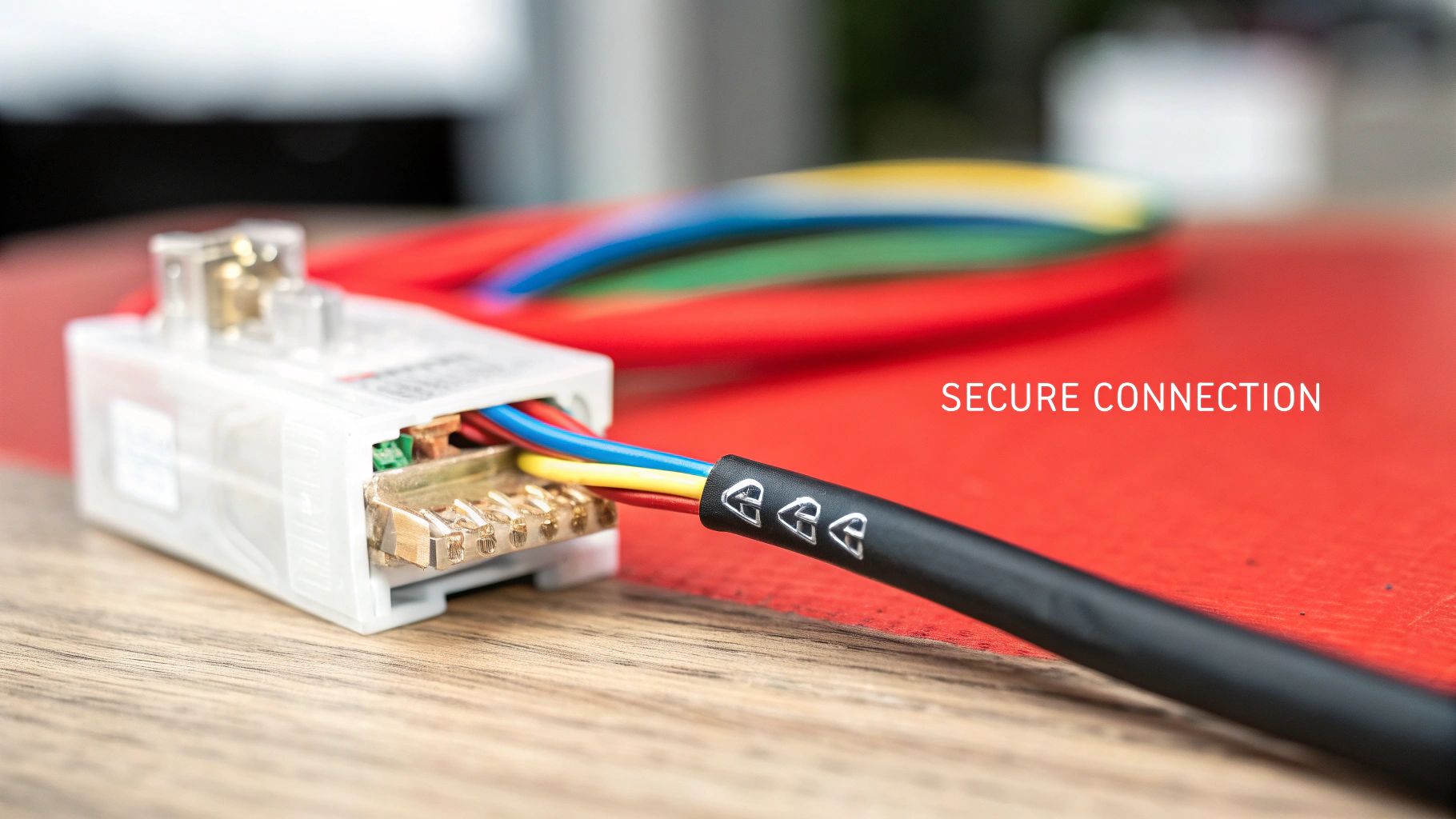
Connecting flexible, multi-stranded wire into a solid terminal block can be messy and create a poor connection. This is where pin type lugs are essential. They consolidate loose strands into a single, solid pin, ensuring a secure, full-contact connection that prevents overheating and power loss in switchgear and control panels across the UAE.
Why Pin Type Lugs Are Critical for UAE & GCC Projects
In the demanding climate of the UAE and GCC, high heat, humidity, and dust are constant threats to electrical integrity. Using certified electrical components isn’t just good practice; it's a necessity. Pin type lugs are specifically designed to solve the termination problems of stranded wires, which can fray and create weak, unreliable connections.
By crimping these strands into a solid pin, you guarantee a termination that's both electrically and mechanically sound. This level of reliability is the foundation of any safe, compliant electrical system in Dubai, Abu Dhabi, or KSA. A poor connection is not just inefficient—it's a serious fire hazard.
Core Benefits in the GCC Context
For engineers, panel builders, and procurement teams in the region, choosing the right pin type lugs offers immediate, practical advantages:
- Enhanced Safety: The solid pin makes maximum surface contact inside a terminal, dramatically reducing the risk of dangerous hotspots and electrical arcing.
- Durable Connections: A properly crimped lug creates a termination that withstands vibration and mechanical stress—critical in industrial plants, high-rise towers, and energy management solutions in Dubai.
- Faster Installation: Lugs slide cleanly into terminal blocks, speeding up assembly and reducing labour costs on projects.
- Meeting Local Standards: Using certified lugs is key to ensuring your panel assemblies comply with stringent local utility regulations from authorities like DEWA and ADDC.
The demand for high-quality electrical components in the UAE is rising. The cable accessories market in the Middle East and Africa was valued at around USD 150 million in 2024, largely driven by massive infrastructure projects. This boom underscores the critical role of high-quality insulated cable lugs in supporting the region's rapid growth.
For businesses involved in installing these components in Dubai, understanding local regulations, such as obtaining a technical service license, is also vital. This guide covers everything from selecting the right materials to mastering installation, ensuring your electrical systems are safe, compliant, and built to last.
Choosing the Right Materials for Peak Performance in a Harsh Climate
When working in the challenging climate of the UAE and the wider GCC, not all pin type lugs are created equal. The material dictates a lug's conductivity, durability, and resistance to environmental stress. Skimping here can lead to premature failure—a significant safety risk and a recipe for costly downtime.
For engineers and procurement teams, specifying the correct materials is non-negotiable for building robust, long-lasting electrical systems. It's about understanding the science that makes a connection reliable for the long haul.
The Foundation: High-Conductivity Copper
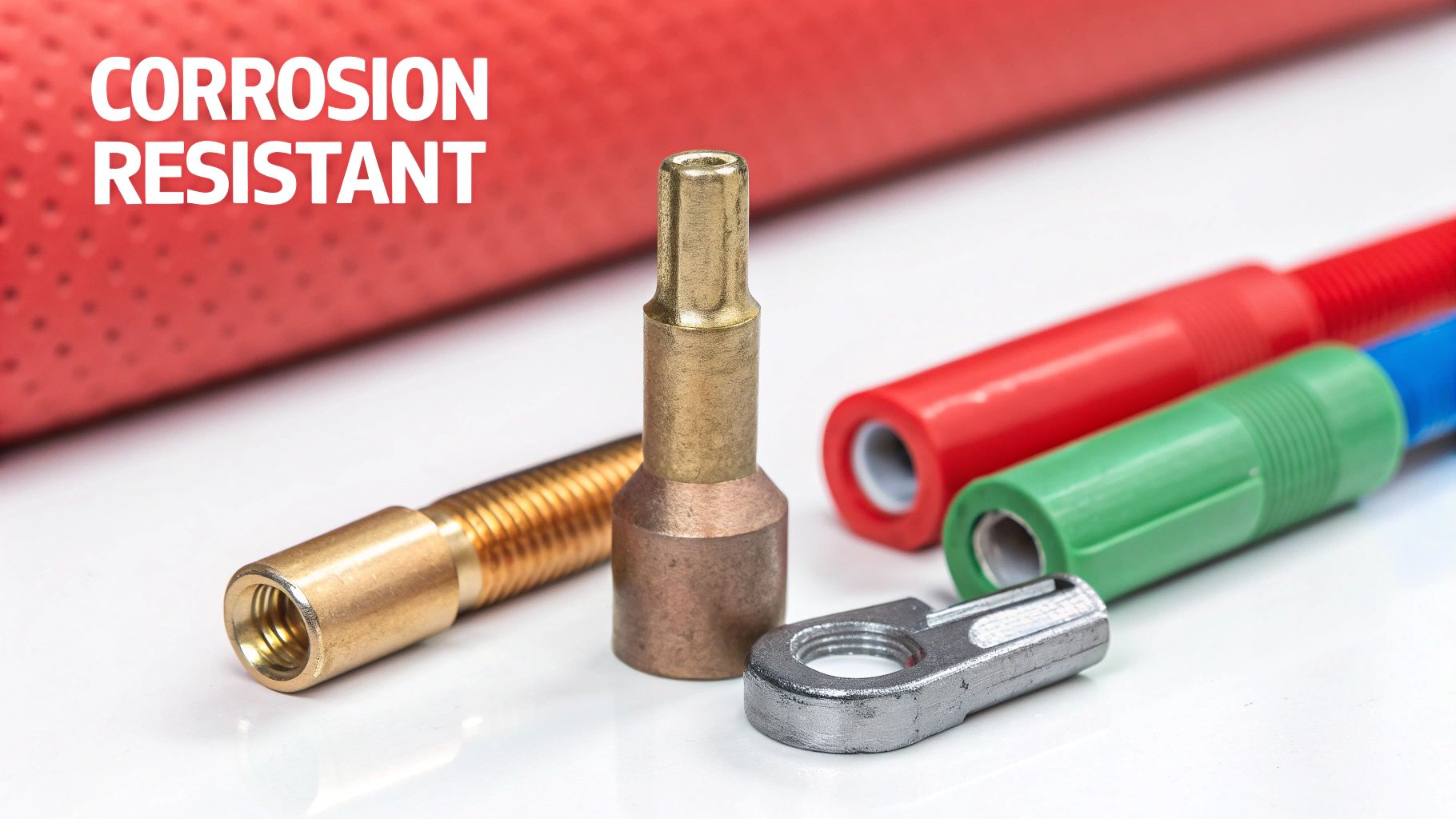
At the heart of any high-performance pin type lug is its conductive body, which must be made from high-conductivity electrolytic copper. This industry standard offers the path of least resistance for electricity, allowing current to flow efficiently with minimal heat buildup.
Using lugs made from inferior alloys or poorly treated copper increases resistance at the termination point. In the high ambient heat of a Dubai summer, that extra heat can quickly degrade wire insulation and become a fire hazard inside a control panel.
The Protective Shield: Tin Plating
Copper’s weakness is oxidation, especially in the humid, saline air common along the GCC coastline. Oxidation forms a resistive layer that can compromise a connection's integrity over time.
To combat this, quality pin type lugs are always electro-tin plated. This thin layer of tin acts as a critical barrier, providing robust protection against corrosion and guaranteeing a stable, low-resistance connection for years. For any project near coastal areas like Jebel Ali or Abu Dhabi, tin-plated lugs are a necessity, not a luxury.
A proper tin plating serves two crucial functions in the GCC environment: it prevents copper oxidation from humidity and salty air, and it provides a softer metal surface that forms a gas-tight, cold-welded connection when crimped correctly.
Insulation Materials for High-Temperature Environments
The insulation on a pin type lug is as vital as its copper core. It must not only prevent accidental contact but also survive the intense heat inside an electrical enclosure. The two most common materials are PVC and Nylon.
- PVC Insulation: A cost-effective choice suitable for general-purpose applications with standard operating temperatures.
- Nylon Insulation: The superior option for high-temperature environments. It offers better resistance to heat, abrasion, and chemicals. For panels exposed to direct sunlight or containing heat-generating components like VFDs, Nylon is the only reliable choice.
Knowing these material differences helps you specify a lug that can handle real-world conditions in the UAE. To explore all termination options, learn more about the different electrical cable lugs types in our detailed guide.
Adhering to Technical Specs and IEC Standards in the GCC
On any electrical project in the UAE, compliance with local regulations is mandatory. Whether dealing with DEWA in Dubai or SEC in KSA, every component must meet strict standards. Choosing a pin type lug requires a careful review of its technical datasheet to ensure it can handle the application safely and reliably.
Getting this right ensures your project passes inspection. Getting it wrong leads to expensive delays. Understanding these specifications empowers engineers and procurement teams to select the right parts from trusted suppliers like GoSwitchgear, ensuring compliance and durability.
What to Look for on the Datasheet
A few specifications on a pin type lug's datasheet are critically important.
- Current Rating (Amperage): The maximum load the lug can carry without overheating. It must be equal to or greater than the cable's current rating.
- Wire Gauge Compatibility (mm²): The datasheet specifies the exact cable size range for the lug. Using the wrong size results in a weak crimp, leading to physical failure or high electrical resistance.
- Operating Temperature Range: This is critical for the UAE, where panels can exceed 50°C. The lug’s insulation (PVC or Nylon) must be rated for this heat to prevent it from becoming brittle or melting.
Why IEC 61238-1 Certification Matters
Beyond basic specs, one standard separates quality components from the rest: IEC 61238-1. This certification guarantees that the lug has passed a series of rigorous tests simulating years of real-world use.
An IEC 61238-1 certified lug is subjected to hundreds of heating and cooling cycles while carrying a full electrical load, proving the connection remains cool, stable, and strong throughout its service life.
This certification confirms two non-negotiable facts:
- Mechanical Strength: The crimped connection will not pull apart under force, making it suitable for high-vibration industrial environments.
- Electrical Stability: The connection’s resistance remains low and stable over time, preventing degradation that leads to overheating and failure.
For any critical connection inside a distribution board or energy management solution in Dubai, insisting on lugs with IEC 61238-1 certification is smart engineering. It is documented proof that the component has been independently verified for performance and safety.
How to Select the Correct Pin Type Lug Size for Your Project
Choosing the right pin type lug requires precision. A lug that is too large or too small can increase electrical resistance, cause dangerous overheating, and lead to eventual failure—complications no project in the demanding UAE and GCC environments can afford.
A perfect fit ensures both mechanical strength and optimal electrical conductivity. This comes down to two key steps: matching the lug's barrel to your cable's size and ensuring the lug's pin fits the terminal.
Matching the Lug Barrel to the Cable Size
First, match the lug’s barrel to the cross-sectional area (CSA) of your stranded copper cable, measured in square millimeters (mm²). This ensures that a crimp forms a solid, void-free connection around all copper strands.
If the lug barrel is too large, the crimp will be loose, leaving air gaps that increase resistance and allow moisture ingress—a major concern in coastal cities like Dubai. Conversely, if the barrel is too small, you cannot insert all the cable strands, forcing technicians to trim them. This reduces the cable's current-carrying capacity and creates a weak point.
The golden rule: The cable's mm² size must correspond exactly to the mm² size stamped on the pin type lug. Always double-check specifications before crimping.
Aligning the Pin with the Terminal Entry
Next, ensure the lug's pin is compatible with the terminal block. This involves checking two dimensions: pin diameter and pin length.
- Pin Diameter: The pin must slide into the terminal easily but not be so small that it wobbles. A loose pin means poor surface contact, leading to weak conductivity and potential arcing.
- Pin Length: The pin must be long enough to fully engage with the terminal’s clamping mechanism but not so long that it creates a short-circuit risk with nearby components.
For panel builders in the UAE working with high-density control panels, getting these pin dimensions right is essential for safety and function. Always consult the terminal block's datasheet to confirm acceptable pin specifications.
Pin Type Lug Sizing Chart for Common Cable Sizes in the UAE/GCC
This reference table helps electricians and engineers match common metric cable sizes used across the region with the correct insulated pin type lugs.
| Cable Cross-Section (mm²) | Recommended Pin Lug Part Number (Example) | Pin Diameter (mm) | Pin Length (mm) | Insulation Colour Code (IEC) |
|---|---|---|---|---|
| 1.5 mm² | PTV1.25-10 | 1.7 | 10.0 | Red |
| 2.5 mm² | PTV2-10 | 2.3 | 10.0 | Blue |
| 4.0 mm² | PTV5.5-12 | 3.2 | 12.0 | Yellow |
| 6.0 mm² | PTV5.5-12 | 3.2 | 12.0 | Yellow |
| 10.0 mm² | PTN14-12 | 4.9 | 12.0 | Red (Non-Insulated Type) |
| 16.0 mm² | PTN22-12 | 6.2 | 12.0 | Blue (Non-Insulated Type) |
Note: These part numbers and dimensions are for illustration. Always check the manufacturer's datasheet for the exact product you're using, which you can find on the GoSwitchgear platform.
This table serves as a quick guide for technicians to ensure every connection is built to last. By systematically matching the barrel to the cable and the pin to the terminal, you can guarantee every termination is mechanically strong and electrically sound.
Best Practices for Installation and Crimping
Even the highest-quality pin type lug is ineffective if installed improperly. The reliability of an entire electrical system often depends on the skill invested in this final step. A perfect crimp creates a connection that is mechanically strong and electrically pure, ready to handle the operational stress of demanding GCC environments. This section provides practical, best-practice guidance for technicians in the UAE to achieve a flawless installation every time.
The Step-by-Step Crimping Process
A professional-grade crimp requires a systematic approach. Rushing these steps or using the wrong tools will compromise the connection's integrity.
Cable Preparation: Strip the cable insulation to a length that perfectly matches the depth of the lug’s barrel. Too little stripping prevents the conductor from seating fully, while too much exposes copper, creating a short-circuit risk.
Conductor Insertion: Lightly twist the exposed copper strands and insert them into the barrel of the pin type lugs, ensuring every strand reaches the bottom.
Tool and Die Selection: Use a calibrated ratcheting crimper with the correct die set that matches the lug's size and color code. Pliers are not an acceptable substitute. The die profile is engineered to apply precise, even pressure.
Executing the Crimp: Place the lug barrel in the die nest. Squeeze the crimper handles with firm, steady pressure until the ratchet mechanism completes its cycle and releases. This auto-release feature guarantees the correct pressure has been applied.
Inspection: A perfect crimp looks uniform with clear die markings. Give the cable a gentle tug to confirm a strong mechanical bond. The insulation should sit flush against the back of the lug with no exposed copper.
This infographic simplifies the initial steps of matching your cable with the right terminal component.
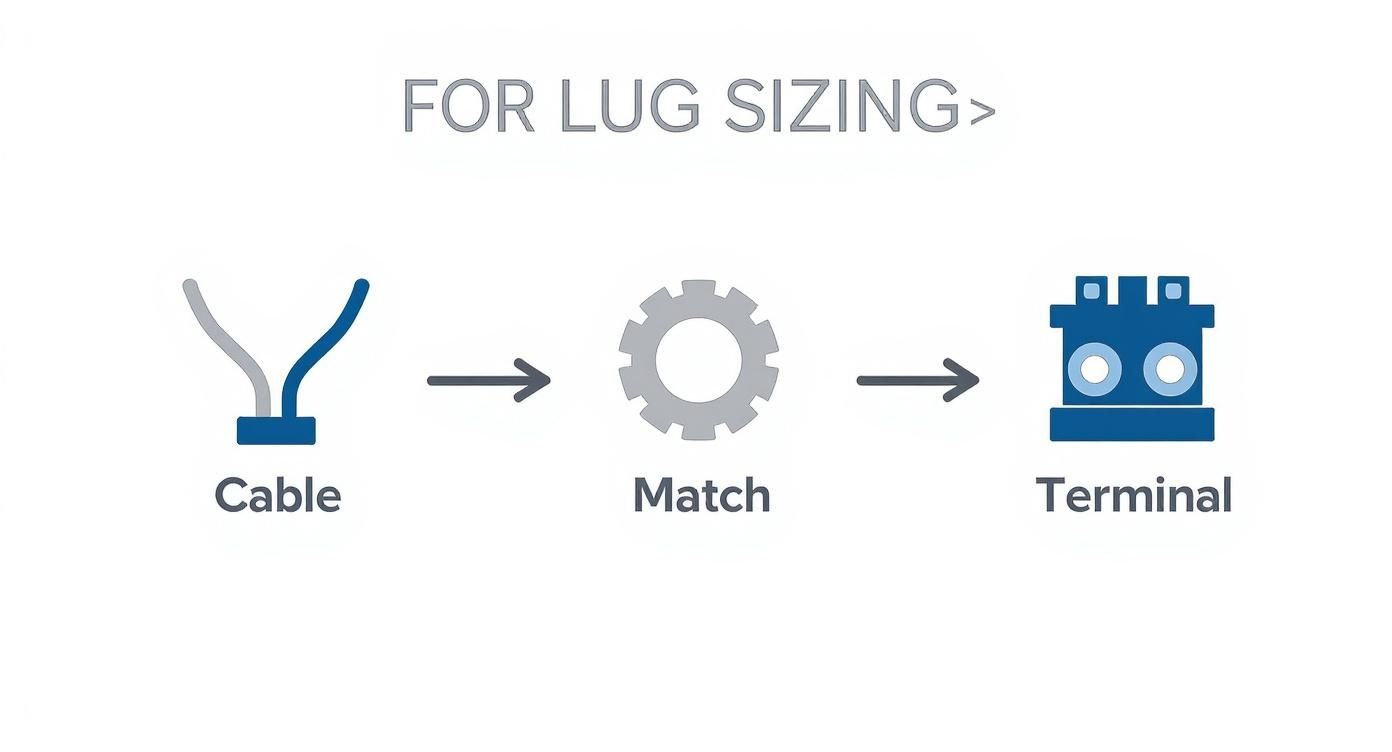
It reinforces the foundational principle: start by correctly matching the cable, lug, and terminal.
Common Installation Mistakes to Avoid
In the high-stakes world of electrical panel building in Dubai and Abu Dhabi, simple mistakes can lead to major failures.
- Using Pliers or Uncalibrated Tools: Pliers create a weak "pinch" instead of a true crimp, leading to a high-resistance connection that will overheat under load. Always use a proper ratcheting tool.
- Under-Crimping: Failing to complete the ratchet cycle leaves gaps, resulting in a loose termination vulnerable to vibration or thermal cycling.
- Over-Crimping: Using a die set that is too small crushes the barrel and damages the conductor strands, reducing current-carrying capacity.
- Trimming Conductor Strands: Never trim strands to force a fit. This indicates the wire is too large for the lug. Use the correctly sized cable and lug instead.
A correctly executed crimp forms a gas-tight, cold weld between the conductor and the lug barrel. This metallurgical bond creates a single, continuous electrical path with minimal resistance, essential for preventing heat generation and ensuring long-term reliability.
By avoiding these pitfalls and adhering to a meticulous installation process, electricians and panel builders can ensure every connection is robust and safe. To see how these connections fit into the bigger picture, explore our guide on the role of cable lugs in control panel systems.
Common Applications of Pin Type Lugs Across the GCC
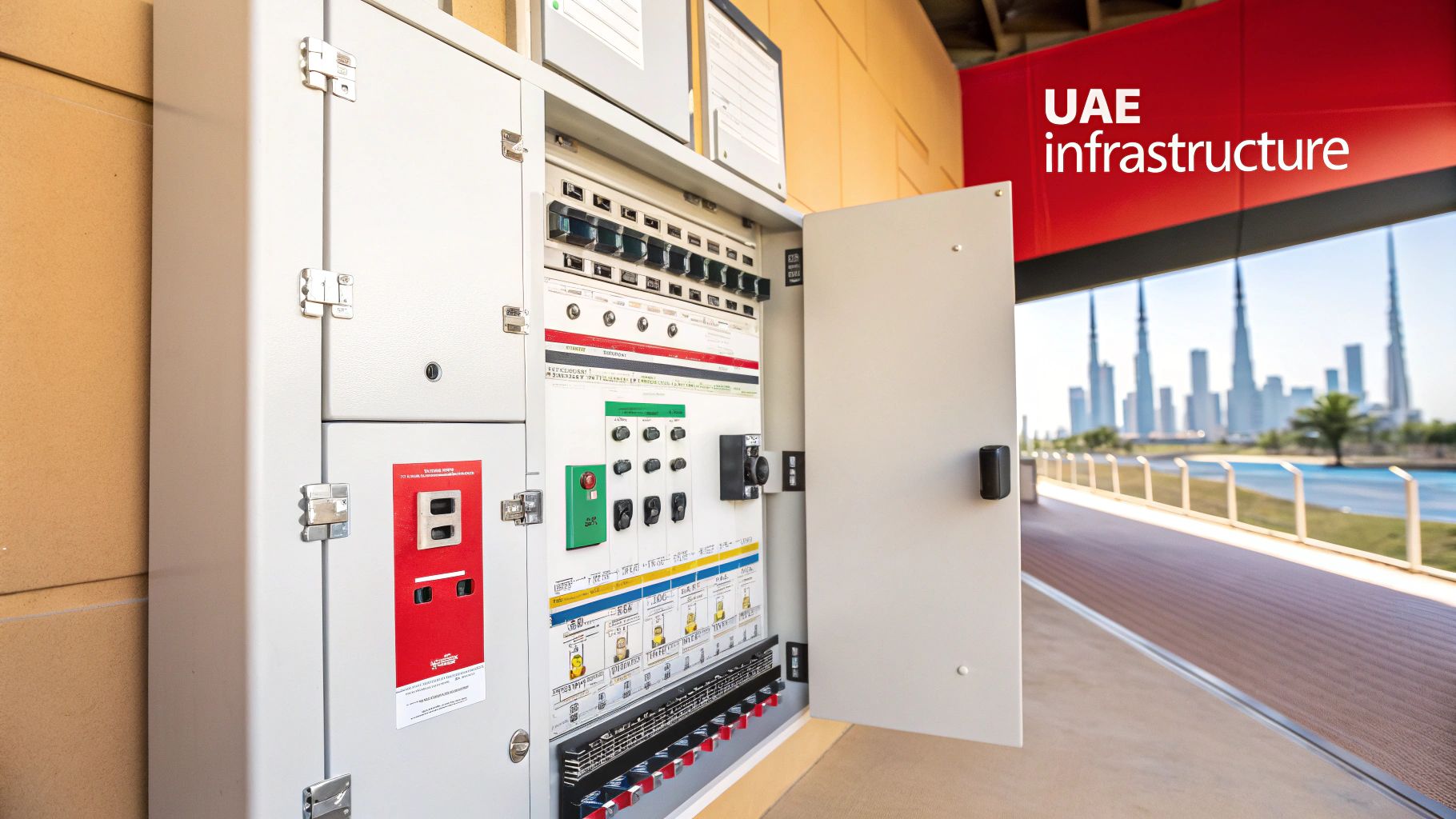
From the control centres of Dubai's skyscrapers to the industrial zones of Abu Dhabi, pin type lugs are the unsung heroes of the region's electrical infrastructure. Their primary application is inside switchgear assemblies and control panels, where they create clean, solid connections for PLCs, contactors, and miniature circuit breakers. By converting a stranded wire into a solid pin, they ensure a perfect fit into terminal blocks, preventing stray strands from causing dangerous short circuits.
Key Application Areas in the Region
The versatility of pin type lugs makes them a go-to component across sectors that power the UAE's economy.
- Industrial Automation and Manufacturing: In facilities across Jebel Ali or Khalifa Industrial Zone, control panels rely on thousands of connection points. Pin type lugs provide the vibration-resistant terminations needed to keep automated production lines running smoothly.
- Renewable Energy Projects: Solar farms in the Dubai desert use inverters and combiner boxes filled with sensitive electronics. Clean, reliable connections from these lugs are vital for maximizing energy output and ensuring long-term system durability.
- Commercial and Residential High-Rises: The complex distribution boards in Downtown Dubai's towers depend on pin type lugs to ensure every circuit is connected safely and securely, which is critical for fire safety and system longevity.
Powering Future-Focused Infrastructure
As the region advances with smart city projects and sustainable transport, the need for dependable electrical connectors is growing. The market for pin and sleeve devices, including pin type lugs, is expanding thanks to these megaprojects. EV charging stations and smart building controls cannot function without flawless connections, driving demand for top-tier components.
This reliance on clean terminations is a constant focus for panel builders. A related topic is the debate over the best connection methods for busbars, which you can explore in our article comparing pin type vs. fork type comb busbars. Understanding these applications makes it clear that the pin type lug is a fundamental building block of the GCC's modern, electrified future.
Your Partner for Reliable Electrical Components in the UAE
In the world of electrical systems, mastering the fundamentals is everything. The humble pin type lug plays a critical role in ensuring the safety and reliability of any installation, especially within the UAE's demanding climate.
Focusing on correct material quality, precise sizing, adherence to standards like IEC 61238-1, and professional installation helps build systems that are not just functional, but durable. This attention to detail is crucial as the region’s infrastructure continues to expand.
The rapid growth in construction across the Middle East is driving huge demand for quality electrical components in the UAE. Saudi Arabia alone has over 5,200 ongoing projects valued at around USD 819 billion as of 2024. This creates a massive need for top-tier connectors like pin type lugs to guarantee system integrity. You can learn more about these trends in the market for cable lugs. This boom highlights the importance of choosing the right supply partner for your projects.
When you prioritize high-quality, compliant components from the start, you are making a long-term investment in your electrical system's safety, efficiency, and resilience against the harsh local environment.
For your next project in Dubai, Abu Dhabi, or anywhere in the GCC, our team is ready to provide expert support and the reliable products you need to succeed.
For project support and to explore our full range of certified pin type lugs, visit GoSwitchgear at https://goswitchgear.com.
Share this post

Related
Posts
A Guide to Choosing AC to DC Converters for UAE & GCC Electrical Systems
Master AC to DC converters with this comprehensive guide for engineers in the UAE & GCC. Learn selection, installation, and...

A Guide to Drill Machine Prices in the UAE for Technical Professionals
Find the best drill machine price in UAE. Our 2026 guide helps contractors and engineers choose the right corded, cordless,...

A Professional’s Guide to Choosing AGM VRLA Batteries in the UAE Climate
Discover why AGM VRLA batteries are the superior power solution for UPS, solar, and industrial systems in the UAE. Get...

How to Choose the Right Lithium Ion Battery Charger for UAE & GCC Projects
Discover how to select the right lithium ion battery charger for UAE projects. This guide covers specs, BMS integration, and...
.jpg)